


California doesn't play by the same billing rules as the rest of the country. Between Medi-Cal policy changes, managed care contracts, and a payer mix that includes some of the largest insurers in the nation, providers here deal with a level of complexity most billing teams outside the state have never had to touch.
That complexity is exactly why generic billing support falls short in California. A provider needs revenue cycle management companies in California that actually understand the state's regulatory environment, not a one-size-fits-all national process applied without local context.
This guide covers the five best options for California providers in 2026, what separates strong RCM from mediocre RCM in this state specifically, and how to make the right call for your practice.
Why California Billing Is Different
Every state has its own quirks, but California's are bigger than most. Providers here are working with:
- Frequent Medi-Cal policy updates that shift coverage rules and reimbursement timelines with little notice
- A dense managed care landscape, with contracts and authorization requirements that vary by plan
- High claim volumes in major metro areas like Los Angeles, San Francisco, and San Diego, where even small inefficiencies compound fast
- Some of the country's largest payers operating locally, including Blue Shield of California, Kaiser Permanente, Anthem Blue Cross, and Health Net, each with its own submission rules and documentation standards
None of this is impossible to manage. But it does mean that revenue cycle management services in California require payer-specific knowledge that a lot of national providers simply don't prioritize.
Providers who get this right treat billing as more than a back-office task. The best RCM services function as revenue integrity solutions, catching errors before they turn into denials, and as ongoing healthcare revenue recovery, working aged claims until they're actually paid instead of writing them off. Add reliable patient billing services on top of that, and a practice gets both cleaner insurance collections and a smoother experience for patients trying to understand their own bills.
What Healthcare Revenue Cycle Management Services in California Should Include
Before comparing providers, it's worth knowing what a complete revenue cycle management solution should actually cover. At minimum, look for:
End-to-end revenue cycle services. This means everything from eligibility verification and coding through claims submission, denial management, and accounts receivable recovery, not just one piece of the process handled in isolation.
Payer-specific expertise. A partner working in California should already know the documentation quirks of Medi-Cal and the major regional carriers, rather than learning them on your claims.
Real medical claims management, not just submission. Getting a claim out the door is the easy part. Real value comes from tracking it, catching denials early, and resolving disputes before they age into write-offs.
Compliance built into the workflow. HIPAA, HITECH, and CMS alignment should be standard, not an upsell.
Transparent reporting. You should be able to see your claim status and collection timelines without picking up the phone.
Not every company offering RCM services in California actually delivers on all five of these. Some focus narrowly on claims submission and call it done, while providers built around healthcare reimbursement solutions treat the entire cycle, from the first eligibility check to the final posted payment, as one connected system.
The 5 Best RCM Companies for California Providers
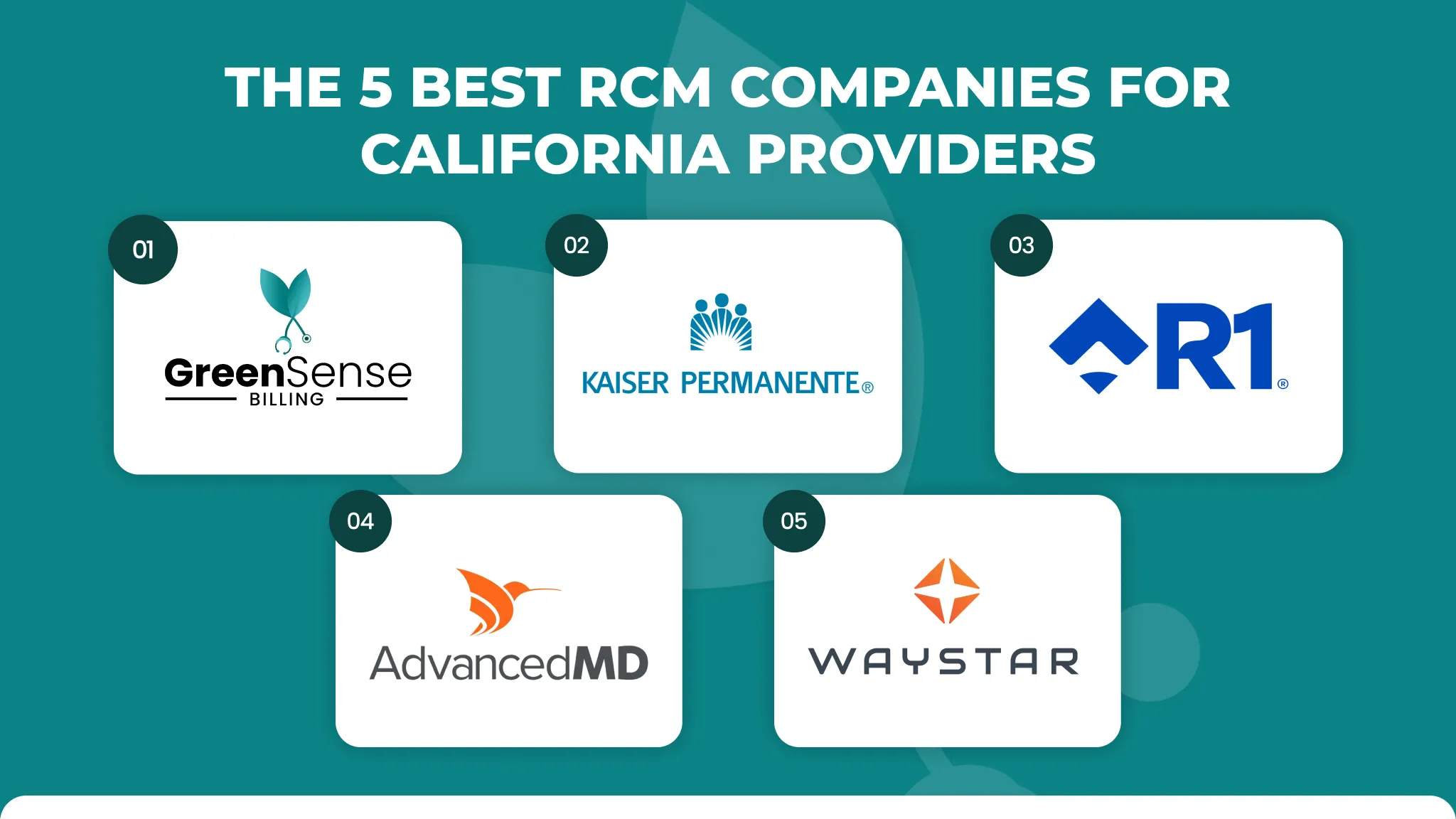
GreenSense Billing
GreenSense Billing brings deep familiarity with California's payer landscape, including direct experience working with Blue Shield of California, Kaiser Permanente, Anthem Blue Cross, and Health Net. That regional knowledge matters because each of these payers has its own submission requirements, and a claim that gets rejected for a formatting issue is revenue sitting idle for no good reason.
The company supports 500+ providers nationwide with a 98% clean claim success rate, and its California-focused work centers on real-time visibility into claims, eligibility verification, and denial patterns, so practices aren't waiting until month-end to find out something went wrong. Services span the full revenue cycle: coding, claims submission, denial management, accounts receivable recovery, and eligibility checks, delivered by a US-based team operating under HIPAA and HITECH-compliant protocols.
For California practices navigating Medi-Cal updates and managed care complexity, this kind of practice revenue enhancement comes from knowing the local rules before a claim is ever filed, not fixing problems after the fact. GreenSense also offers a free revenue cycle audit, giving practices a clear look at where claims are getting stuck before committing to anything.
Kaiser Permanente Revenue Cycle Operations
As both a major California payer and a massive integrated health system, Kaiser Permanente runs its own internal revenue cycle operations at enormous scale. While not a third-party RCM vendor other practices can hire, its billing infrastructure is worth understanding because so many California providers interact with it directly as a payer, and its documentation standards influence how the rest of the state's billing companies build their processes.
R1 RCM
R1 RCM operates across California's hospital systems and larger physician groups, managing the revenue cycle from pre-registration through underpayment recovery. Heavy use of automation lets R1 handle high claim volumes efficiently, which fits well with California's dense metro markets. The tradeoff is that R1's enterprise focus means smaller independent practices may not get the same individualized attention as larger health systems do.
AdvancedMD
AdvancedMD offers billing software paired with revenue cycle support, aimed at specialty clinics and multi-location practices across California. Its platform-based model gives practices tools to manage more of their own billing process, which can work well for groups that already have some internal billing capability and want better software behind it rather than a fully outsourced team.
Waystar
Waystar rounds out this list as a technology-first option, automating claims processing and denial tracking for practices and health systems that want to modernize their existing billing operations rather than hand the whole function over to an outside team. California practices with established internal billing staff often use Waystar's platform to reduce manual errors in high-volume environments.
How to Choose Between These Options
The right revenue cycle management solutions for a California practice depend on two things: your practice size and how much you want to outsource versus manage internally.
Larger hospital systems with high claim volumes tend to fit best with R1 RCM's enterprise scale. Practices with existing billing staff who want better tools often lean toward AdvancedMD or Waystar's platform-based approach. But for independent practices and specialty groups that want a dedicated team handling everything from Medi-Cal documentation to Blue Shield submission rules, outsourcing revenue cycle management services to a California-experienced partner like GreenSense Billing tends to deliver the fastest, most consistent results.
Frequently Asked Questions
What makes RCM different in California compared to other states?
California's billing complexity comes from its dense managed care landscape, frequent Medi-Cal policy changes, and the presence of major regional payers like Blue Shield of California and Anthem Blue Cross, each with distinct submission and documentation requirements.
How much do revenue cycle management services cost in California?
Most RCM providers charge between 3% and 8% of monthly collections, with the rate depending on claim volume, specialty, and the scope of services included in the agreement.
Do I need a California-specific RCM provider, or will a national company work?
A national provider can work, but one with direct experience in California's payer mix, particularly Medi-Cal and the state's major managed care plans, will typically catch payer-specific issues faster than a team learning the state's rules from scratch.
What's included in end-to-end revenue cycle services?
A complete offering includes eligibility verification, medical coding, claims submission, denial management, accounts receivable recovery, and payment posting, all working together rather than as separate, disconnected services.
How long does it take to onboard a new RCM partner in California?
Most established providers complete onboarding within 5 to 10 business days, including data migration, EHR integration, and payer-specific setup for the plans your practice works with most.
Final Thoughts
California's billing environment doesn't leave much room for generic solutions. Between Medi-Cal's shifting policies and a managed care system with some of the country's largest payers, providers need revenue cycle management companies in California that already understand the terrain.
Enterprise systems may lean toward R1 RCM's scale, and practices with internal billing teams might prefer a platform like AdvancedMD or Waystar. But for independent practices and specialty groups that want a true end-to-end partner, GreenSense Billing's California-specific payer expertise makes it the strongest option on this list.
Curious how much revenue your practice could be recovering? Request a free revenue cycle audit from GreenSense Billing and get a clear, California-specific answer.
