
How to Choose a Denial Management Vendor

Authored by Blog Post Management Dashboard on November 10, 2026 · 12 minutes read



Key Takeaways
- Choose the right model Choose the right operational model: Decide whether your practice needs denial management software (internal execution), an outsourced service team (external execution), or full RCM.
- Prevent upstream Focus on upstream denial prevention: Prioritize vendors that feed root causes back to front-end registration, insurance verification, prior authorization, and medical coding workflows.
- Standardized metrics Require standardized metric definitions: Demand clear, written formulas for net denial rates, appeal overturn rates, and days to resolution so performance can be audited against your internal PM software.
- Multi-level appeal depth Verify multi-level appeal depth: Ensure the vendor handles multi-tier appeals; Medicare Fee-for-Service maintains five distinct appeal levels with strict regulatory deadlines.
- Protect claim data Protect claim data access: Require a signed Business Associate Agreement (BAA) and secure platform integration before sharing claim files.
A good denial management vendor prevents denials upstream and recovers revenue downstream. Judge vendors on five pillars: prevention vs recovery, transparent metric definitions, multi-level appeal depth, clear pricing, and HIPAA security with a signed BAA. Software, outsourced teams, full RCM and complex-recovery firms fit different practices.
Selecting a denial management vendor requires evaluating how effectively a partner prevents recurring rejections while recovering unpaid revenue. Physician practices often struggle to determine whether they need specialized analytics software, an outsourced team of billing specialists, or an end-to-end revenue cycle management partner. How to choose a denial management company? Answering this simple question is not that easy. Choosing a denial management partner, base your decision on five core pillars:
- Prevention vs. recovery capability: Resolving root causes versus chasing unpaid claims.
- Transparent reporting metrics: Standardized definitions you can reconcile inside your practice management (PM) system.
- Payer appeal depth: Escalating multi-level appeals for Medicare and commercial insurers.
- Clear pricing structures: Contingency, percentage of collections, or fixed FTE rates.
- System security: Full HIPAA compliance and a signed Business Associate Agreement (BAA).
How to choose a denial management company?
Base your decision on five core pillars: prevention vs recovery capability, transparent reporting metrics, payer appeal depth, clear pricing structures, and system security. The right model depends on your practice size, internal staffing, and denial volume — software, an outsourced team, or full RCM.
What is denial management?
Denial management is the process of preventing, tracking, appealing and recovering denied claims. It covers root-cause prevention at the front end, multi-level payer appeals, and overturn recovery. General accounts receivable management is different: it covers all unpaid claims, including pending, clean claims awaiting normal payer processing.
- CARC
- A Claim Adjustment Reason Code is the standardized code a payer uses to explain why a claim was denied or adjusted.
- RARC
- A Remittance Advice Remark Code is a supplemental code that adds detail to a CARC on the remittance advice.
- ERA
- An electronic remittance advice is the electronic file (X12 835) a payer sends to explain claim payments and denials.
- BAA
- A business associate agreement is a signed agreement that requires a vendor to protect patient health information (PHI).
Evaluation Scorecard: Choosing a Denial Management Vendor
Use this scorecard when evaluating a prospective claim denial management company:
| Criterion | What to Ask | Strong Answer | Red Flag |
|---|---|---|---|
| Delivery Model | Are you selling software, a managed service, or a hybrid? | Clear operational boundary explaining who works individual claim rejections. | Software marketed as a "managed service" without dedicated account staff. |
| Prevention Capability | How do you reduce future denial volume? | Automatically routes root causes back to eligibility, authorization, and coding teams. | Focuses exclusively on post-denial appeals without upstream feedback loops. |
| Claim Categorization | How are rejections classified? | Standardized mapping by CARC/RARC codes, payer rules, provider, and CPT. | Grouping distinct rejections into generic "unpaid" or "denied" buckets. |
| Appeal Depth | Which appeal levels do you manage? | Manages Level 1 redeterminations through Level 2 QIC reconsiderations and beyond. | Only handles initial automated electronic claim resubmissions. |
| Metrics & Reporting | Which KPIs are tracked, and how are they defined? | Written mathematical formulas reconciled weekly against your PM system. | Shiny analytics dashboards with no transparent metric formulas. |
| Specialty Expertise | Do you understand our specialty's coding rules? | Demonstrates experience with modifier rules, incorrect use of modifiers, and specialty authorizations. | Generic answers that ignore specialty-specific billing edits. |
| Pricing Model | Do you charge contingency, collection percentage, or flat fees? | Written definition of billable recoveries that excludes routine posting. | Assessing fees on claims resolved by internal staff or routine auto-adjudication. |
| System Access | How do your specialists work? | Operates directly within your clearinghouse and PM software with full audit logs. | Requires unmonitored raw data exports out of your secure platform. |
| Compliance | Will you sign a BAA prior to system integration? | Executes a signed BAA immediately alongside verified security controls. | Delays or hesitates to execute a formal Business Associate Agreement. |
Denial Management Delivery Models
1. Denial Management Software Platforms
- Best for: Large physician groups or health systems with experienced internal billing teams needing better workflow automation.
- What it does: Software vendors provide automated analytics, claim tracking dashboards, and workflow engine tools. Aggregates X12 835 ERA files, categorizes Claim Adjustment Reason Codes (CARC) and Remittance Advice Remark Codes (RARC), and auto-populates appeal letters.
- Typical pricing model: Fixed monthly subscription fee or per-provider license fee.
- Limitations: Your internal billing staff remains responsible for researching, writing, and submitting every appeal.
2. Outsourced Denial Management Services
- Best for: Independent practices and group practices where internal staff cannot keep up with rising claim rejections.
- What it does: Dedicated billing services deploy certified specialists to research, write, and submit appeals directly within your practice workflows. Specialists audit denied claims, correct coding errors, manage prior authorization appeals, and communicate directly with payers. For example, GreenSense Billing provides specialized denial management services that operate directly inside a practice's existing software.
- Typical pricing model: Percentage of recovered revenue or a contingency fee structure.
- Limitations: Requires seamless operational communication between external specialists and internal clinical staff.
3. Full Revenue Cycle Management (RCM) Outsourcing
- Best for: Practices seeking to offload all billing, coding, claim follow-up, and denial resolution to one unified partner.
- What it does: An end-to-end billing partner that handles every stage of the revenue cycle, from initial eligibility verification to patient collections. Manages front-end patient intake, charge entry, claim submission, payment posting, denial resolution, and A/R recovery.
- Typical pricing model: Percentage of total net practice collections.
- Limitations: Represents a broader operational transition than hiring a standalone denial recovery vendor.
4. Specialized Complex Recovery Firms
- Best for: Practices with large backlogs of high-value hospital or surgical denials that have exhausted standard appeal avenues.
- What it does: Legal and clinical coding teams review clinical documentation to fight complex medical necessity denials.
- Typical pricing model: Higher contingency fees (typically 15% to 30% of recovered dollars).
- Limitations: Generally unsuited for routine, low-dollar administrative claim denials.
Metrics to Require From Any Denial Management Vendor
To ensure your denial management outsourcing for medical practices yields measurable results, require written definitions for these core metrics:
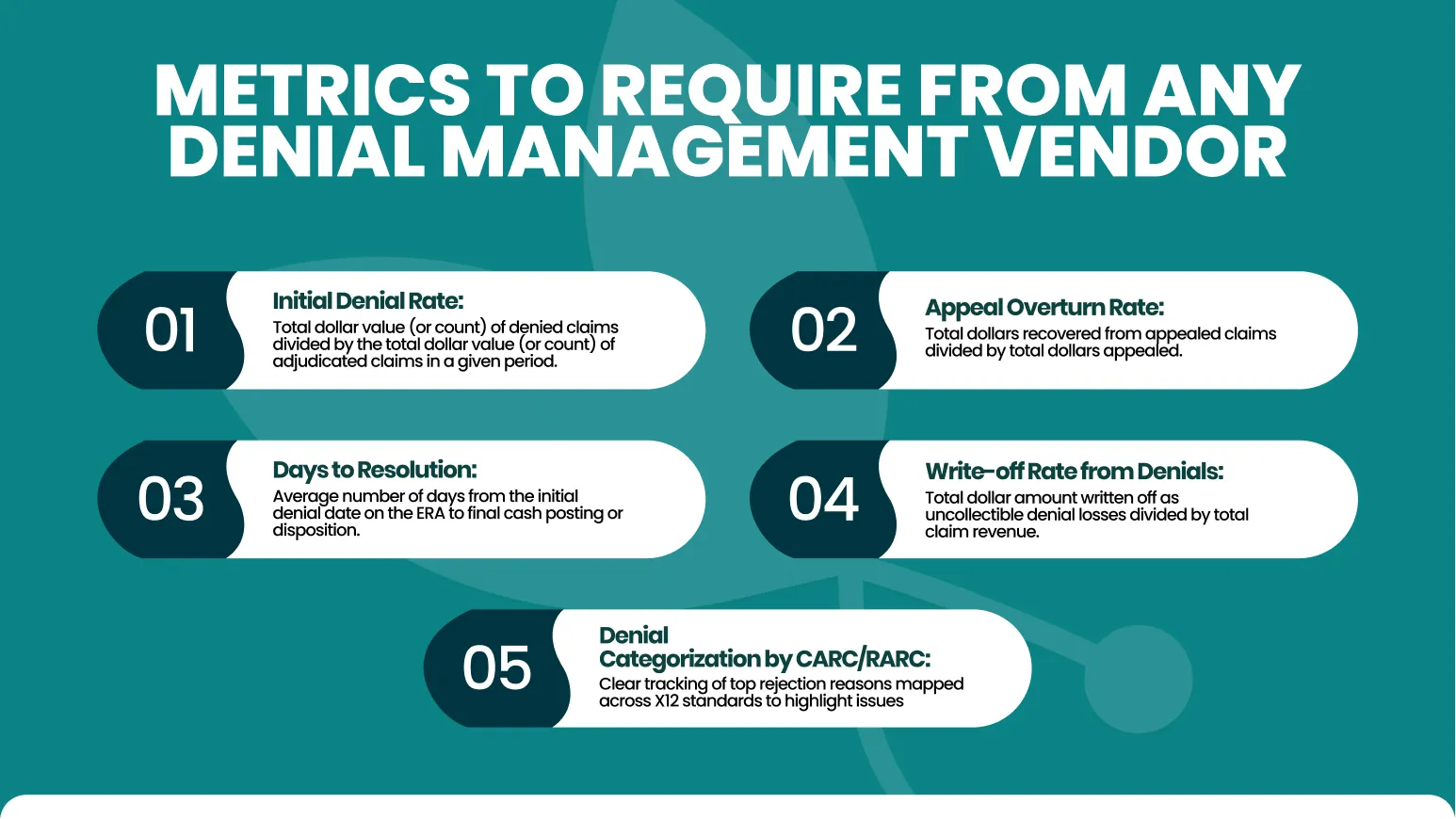
- Initial Denial Rate: Total dollar value (or count) of denied claims divided by the total dollar value (or count) of adjudicated claims in a given period.
- Appeal Overturn Rate: Total dollars recovered from appealed claims divided by total dollars appealed.
- Days to Resolution: Average number of days from the initial denial date on the ERA to final cash posting or disposition.
- Write-off Rate from Denials: Total dollar amount written off as uncollectible denial losses divided by total claim revenue.
- Denial Categorization by CARC/RARC: Clear tracking of top rejection reasons mapped across X12 standards to highlight issues like unbundling services and NCCI edit violations.
Regulatory Appeal Windows to Track
For Medicare Fee-for-Service claims, any outsourced denial management partner must strictly monitor regulatory deadlines across all five appeal levels:
- Level 1 (Redetermination): Filed with the Medicare Administrative Contractor (MAC) within 120 days of receiving the initial determination.
- Level 2 (Reconsideration): Filed with a Qualified Independent Contractor (QIC) within 180 days of the redetermination notice.
- Level 3 (Administrative Law Judge): Filed with the Office of Medicare Hearings and Appeals (OMHA) within 60 days of the QIC decision.
- Level 4 (Medicare Appeals Council): Filed within 60 days of the ALJ decision.
- Level 5 (Federal District Court): Filed within 60 days of the Medicare Appeals Council decision.
Commercial payer deadlines vary by contract, making automated deadline tracking essential for every denial management service for physicians partners.
Decision Block: Software vs. Managed Service
Software is enough when:
- Your practice maintains an experienced, fully staffed internal billing department.
- Denial spikes stem from minor clearinghouse formatting errors rather than complex clinical rejections.
- You simply need better dashboard visibility to delegate appeal tasks internally.
You need an outsourced service when:
- Internal staff is overwhelmed by day-to-day billing and lacks time to write complex clinical appeals.
- Your denial rate exceeds internal targets due to front-end errors, missing prior authorizations, or coding mistakes.
- You need specialized coding expertise to challenge improper payer bundling edits and modifier denials.
When evaluating front-end prevention, ensure your staff verifies coverage before visits using automated insurance eligibility verification and uses certified medical coding services.
Questions to Ask in a Vendor Demo
- Do you provide software tools, dedicated billing specialists, or a combination of both?
- How does your workflow feed denial root causes back to our front-desk intake staff?
- How do you map payer denial reasons using X12 CARC and RARC code standards?
- Will your specialists work claims directly inside our existing PM and clearinghouse software?
- How do you track strict filing deadlines for Medicare redeterminations and commercial appeals?
- What explicit mathematical formula do you use to calculate appeal overturn rates?
- How does your pricing model distinguish between claims resolved by your team versus routine payments?
- Do you execute a formal Business Associate Agreement (BAA) before integration?
Frequently Asked Questions
Can a denial management vendor work inside my existing PM system?
Yes. Professional denial management companies routinely operate directly within your existing practice management software and clearinghouse, maintaining complete audit trails.
Do denial management companies charge only on recovered claims?
Many service-based vendors charge a contingency fee based strictly on dollars recovered from denied claims. However, software platforms charge fixed monthly subscription fees, and full RCM providers charge a percentage of overall net practice collections.
What denials are not worth appealing?
Claims rejected for unappealable statutory reasons; such as claims exceeding mandatory timely filing limits under Medicare (42 CFR 405.926(n)), cannot be appealed and must be adjusted per regulations.
How quickly should a vendor work a new denial?
A top way to choose a denial management company criterion is speed. Vendors should review and route new claim denials within 24 to 48 hours of electronic remittance advice (ERA) posting to avoid missing contractual appeal windows.
Is denial management the same as AR follow-up?
No. General accounts receivable management covers all unpaid claims, including pending, clean claims awaiting normal payer processing. Denial management specifically focuses on rejections, clinical appeals, root-cause prevention, and overturn recovery.
Also read
Billing support
For practices that need help beyond this guide, GreenSense Billing covers medical billing services, medical coding services, and revenue cycle management.
Conclusion: Choosing the right partner transforms denial management from reactive claim chasing into systematic revenue prevention. Discover how GreenSense Billing's specialized denial management services can help your practice recover lost revenue and prevent future claim rejections.
Published .
Sources
- CMS, Medicare Fee-for-Service Appeals Process (Five Levels)
- AAPC, Understanding the 5 Levels of Medicare Appeals
- 42 CFR § 405.926, Actions That Are Not Initial Determinations
- X12, Claim Adjustment Reason Codes (CARC) Standard Reference
- KLAS Research, Revenue Cycle & Denial Management Reports
- HHS, Business Associate Agreement Provisions & HIPAA Compliance


More Related Posts

-

November 5, 2026
Billing GuidesHow to Choose a Medical A/R Recovery Company
How to choose a medical A/R recovery company: compare vendor types, score pricing and compliance, triage old AR, and check Medicare timely f...
-

November 4, 2026
Billing GuidesBest Medical Billing Companies for Psychiatry
The best medical billing companies for psychiatry — GreenSense Billing, Practolytics, MedCare MSO, OmniMD and PGM Billing — compared on pres...