
How to Choose a Medical A/R Recovery Company

Authored by Sara Williams on November 5, 2026 · 11 minutes read



In healthcare administration, medical A/R recovery refers either to unpaid insurance claim follow-up or to patient debt collection. Choosing the right medical A/R recovery company requires understanding this distinction, as insurance claim processing and patient collection agencies involve completely different regulations, workflows, and pricing structures.
Selecting an insurance AR follow-up company to clean up aged balances can restore cash flow after staff turnover, clearinghouse shifts, or billing disruptions. This guide breaks down vendor models, evaluation criteria, and essential prep work needed before outsourcing your accounts receivable.
To select the best medical accounts receivable recovery company for your practice, evaluate their industry reputation, technological capabilities, transparent reporting, and proven track record in recovering aged claims while maintaining strict compliance.
Key Takeaways
- Distinguish insurance recovery from patient debt: Insurance claim recovery focuses on resolving unpaid claims with payers, while collection agencies collect balances directly from patients under consumer protection laws.
- Triage old claims before hiring a vendor: Unpaid claims must be audited against payer deadlines first. Medicare mandates filing within 12 months of the service date (42 CFR 424.44), and late claim denials cannot be appealed.
- Understand pricing structures: Compare vendor fees carefully, looking at contingency fees on recovered funds, overall revenue percentages, or flat project fees.
- Clarify billable recoveries: Define exact terms for what constitutes a recovered claim so you only pay fees on balances directly resolved by the vendor’s actions.
- Demand root-cause tracking: Ensure your partner provides detailed denial tracking to prevent aged AR recovery for medical practices from becoming a recurring issue.
- Verify regulatory compliance: A signed Business Associate Agreement (BAA) is legally required under HIPAA before granting any external party access to claims and patient records.
A/R Recovery Evaluation Scorecard
Use this criteria checklist to evaluate prospective vendors for accounts receivable recovery outsourcing:
| Criterion | What to Ask | Strong Answer | Red Flag |
|---|---|---|---|
| Scope | Do you work payer AR, patient balances, or both? | Clear separation between insurance claims and patient billing. | “We collect everything” without distinguishing workflows. |
| Aging Accepted | Which aging buckets do you handle? | Evaluates claims past 120 days after reviewing timely filing limits. | Only cherry-picks young, easy claims. |
| Timely Filing Triage | How do you process claims near filing limits? | Checks payer-specific deadlines prior to commencing work. | Fails to verify filing and appeal windows. |
| Pricing Model | Do you charge contingency, collection percentage, or flat fee? | Clear, written definitions detailing billable recoveries. | Assessing fees on auto-posted payments or routine income. |
| System Access | How do you access our platform? | Works directly inside your system with complete audit trails. | Requests unmonitored data exports outside your software. |
| Reporting | What weekly reports do you generate? | Detailed breakdowns of payer status, denial reasons, and write-offs. | Provides only monthly lump-sum totals without detail. |
| Root Cause Analysis | Do you identify why claims aged? | Categorizes denial reasons to improve front-end workflows. | Focuses solely on short-term collection without prevention. |
| Compliance | Do you sign a BAA and observe FDCPA rules? | Provides a signed BAA and adheres to fair debt practices. | Hesitates or refuses to sign a mandatory BAA. |
| Exit Terms | What happens to open items upon termination? | Clean handoff documentation with zero hidden tail fees. | Enforces long, automatic contract renewals with restrictive terms. |
Next Step: Request a free aged AR recovery for medical practices audit to review your current claims backlog. Contact GreenSense Billing for an aging analysis.
Before You Hire Anyone: Triage Your Old AR
Before bringing in an old AR cleanup services provider, evaluate your outstanding balances to establish realistic recovery expectations. Executing a systematic internal audit prevents paying fees on uncollectible claims and improves overall revenue recovery in medical billing.
- Pull detailed aging reports: Group unpaid claims by payer into 30, 60, 90, 120, and 120+ day aging buckets.
- Review timely filing limits: Identify claims approaching final submission deadlines. Medicare requires initial claims to be submitted within 12 calendar months from the date of service (42 CFR 424.44). Commercial contracts and state Medicaid programs often enforce much tighter limits, ranging from 90 to 180 days.
- Verify appeal windows: Flag denied claims that remain inside active appeal windows. Under Medicare Part B guidelines, initial appeal redetermination requests must be filed within 120 days from the date of the initial remittance advice.
- Separate insurance and patient balances: Keep payer claims separate from self-pay balances to ensure proper workflow assignment.
- Estimate net collectible value: Calculate true expected revenue after removing claims that exceed statutory filing limits.
A/R Recovery Triage Workflow
Step 1: Pull Aging Report
Segment 30 / 60 / 90 / 120+ Day Buckets
Step 2: Check Limits
Verify Timely Filing (Medicare 12 Months)
Step 3: Flag Appeals
Verify Redetermination Windows (120 Days)
Step 4: Separate Accounts
Split Insurance Claims from Patient Debts
Vendor Types for Medical A/R Recovery
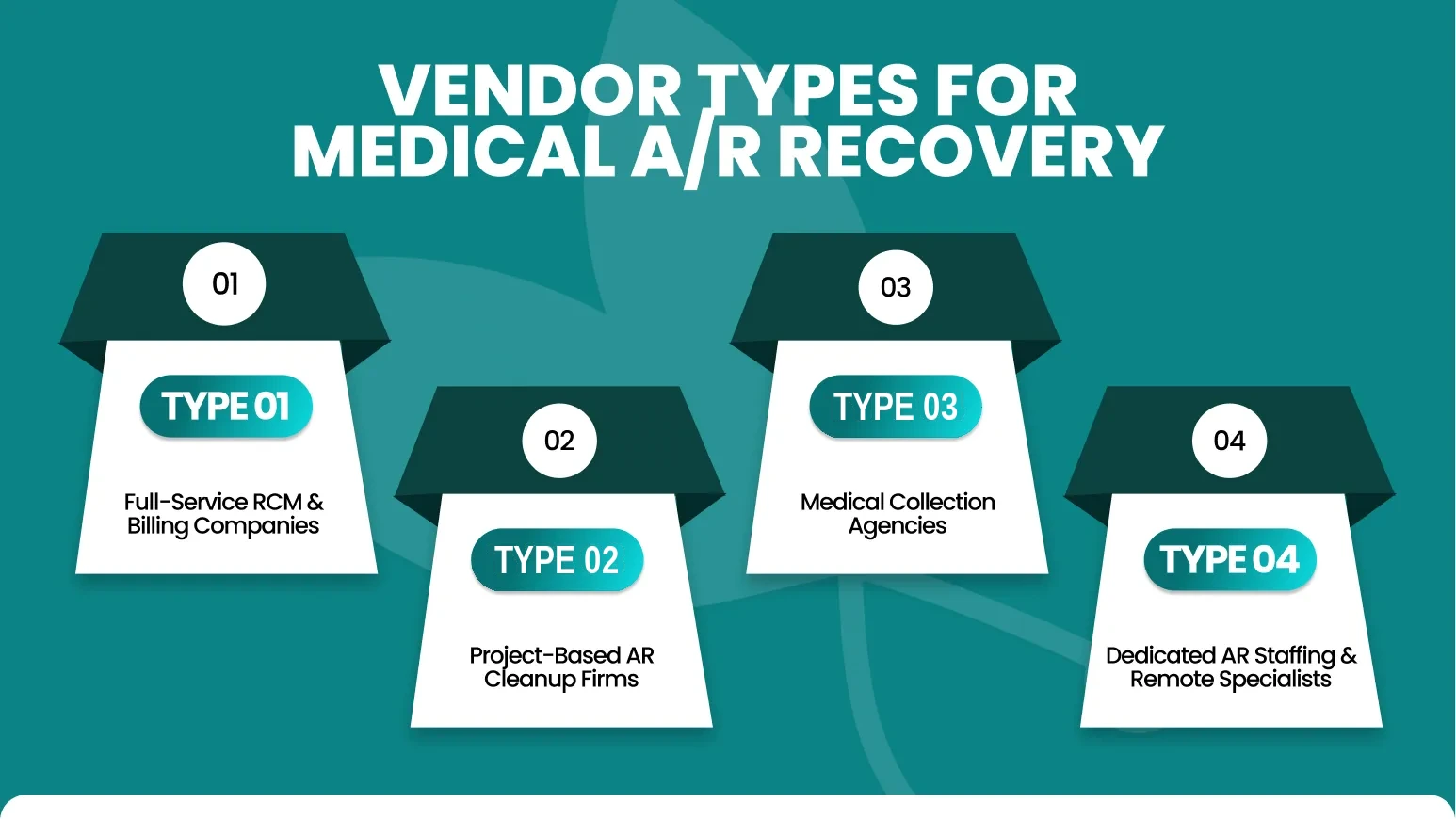
1. Full-Service RCM & Billing Companies
Full-service revenue cycle management firms provide ongoing billing, claim processing, and claims follow-up.
- Best for: Practices seeking long-term revenue cycle management combined with continuous A/R support.
- What it covers: End-to-end claim creation, insurance eligibility checks, payment posting, denial management, and ongoing claim management. For example, GreenSense Billing provides comprehensive accounts receivable management embedded directly into standard billing workflows.
- Typical pricing model: Percentage of total net monthly practice collections.
- Limitations: May not accept standalone, short-term cleanup projects if you prefer to keep initial billing in-house.
2. Project-Based AR Cleanup Firms
Specialized consulting firms handle temporary, high-volume claims backlogs caused by system transitions or staffing shortages.
- Best for: Practices with a one-time backlog of aged claims requiring concentrated resolution effort.
- What it covers: Targeted auditing, re-filing, and resolution of claims within designated aging buckets.
- Typical pricing model: Contingency fee based solely on recovered balance dollars, or a structured project fee.
- Limitations: Once the project concludes, ongoing operational issues may cause claims to age again unless root causes are corrected.
3. Medical Collection Agencies
Collection agencies specialize in recovering delinquent self-pay balances directly from patients.
- Best for: Recovering unpaid patient balances after internal billing statements go unpaid.
- What it covers: Patient outreach through calls, letters, and payment negotiation subject to state and federal debt collection laws.
- Typical pricing model: High contingency fees, often ranging from 25% to 50% of recovered patient funds.
- Limitations: Unsuitable for insurance claim follow-up and requires strict adherence to the Fair Debt Collection Practices Act (FDCPA).
4. Dedicated AR Staffing & Remote Specialists
Staff augmentation agencies provide dedicated billing specialists who operate directly under your practice management team.
- Best for: Practice administrators who want to maintain internal control over workflows while scaling up staff capacity.
- What it covers: Direct claim follow-up, payer phone calls, and routine re-submissions directed by your team.
- Typical pricing model: Hourly rates or fixed monthly fees per full-time equivalent (FTE) staff member.
- Limitations: Requires ongoing supervision, internal training, and active operational oversight from your management team.
Outsource vs. In-House Decision Matrix
Choosing whether to hire a healthcare AR recovery partner or manage cleanup internally depends on your current volume and internal capacity:
Outsource when:
- Aged balances beyond 90 days exceed 15% to 20% of total A/R.
- In-house staff lacks time to work complex denials alongside daily claim submissions.
- Clearinghouse migrations or EHR changes created an unmanageable backlog.
- You need immediate, specialized expertise without long-term overhead costs.
Keep in-house when:
- Your total A/R remains small, manageable, and largely under 60 days old.
- Claims delays stem from minor, easily fixable internal documentation steps.
- Your practice management platform limits external system access.
When evaluating operational structures, review your overall revenue cycle management options. Comparing in-house vs. outsourced revenue cycle management helps clarify resource allocation.
Also read
Selecting an experienced medical AR recovery services partner resolves outstanding claim backlogs, addresses root causes of denials, and stabilizes cash flow. Discover how our specialized accounts receivable management solutions can help your practice clean up outstanding balances and protect revenue.
Frequently Asked Questions
Can an AR recovery company work claims past timely filing?
No. Payers automatically reject claims submitted past their contractual timely filing limit unless a statutory exception applies, such as a formal administrative appeal or retroactive patient eligibility adjustment.
Will an AR recovery company contact my patients?
An insurance AR follow-up company focuses on communicating directly with commercial and government insurance payers. Patient contact occurs only if you specifically hire a patient collection agency or include patient self-pay collection in your service agreement.
Do AR recovery companies charge on all collections or only recovered claims?
Pricing depends entirely on the contractual structure. Project-based vendors typically charge a contingency fee limited to specific recovered claims, whereas full-service RCM vendors charge a set percentage of total monthly net practice collections.
How long does an AR cleanup project usually take?
Project duration varies depending on total claim volume, payer responsiveness, initial denial complexity, and system access speed. Most targeted cleanup projects run between 60 and 120 days.
Do I need a BAA with an AR recovery company?
Yes. Under HIPAA privacy standards, any vendor accessing protected health information (PHI) to process claims or audit accounts must execute a formal Business Associate Agreement before accessing practice data.
Sources


More Related Posts

-

November 3, 2026
Billing GuidesICD-10 Codes for Depression: F32 vs F33 Explained
F32 codes a single depressive episode; F33 codes recurrent major depressive disorder. Neither category is billable alone — choose the comple...
-

November 2, 2026
Billing GuidesICD-10 Code F41.1: Generalized Anxiety Disorder
F41.1 is the billable FY2027 ICD-10-CM code for generalized anxiety disorder. Use it when the provider documents generalized anxiety disorde...
-

October 30, 2026
Billing GuidesICD-10 Code F41.9: Anxiety Disorder, Unspecified
F41.9 is a billable FY2027 ICD-10-CM code for anxiety disorder, unspecified — but it is not a default. Use it only when the provider documen...
-

October 29, 2026
Billing GuidesICD-10 Code F33.1: Major Depressive Disorder, Recurrent, Moderate
F33.1 is a billable FY2027 ICD-10-CM code for major depressive disorder, recurrent, moderate. Use it when the provider documents a recurrent...
-

October 26, 2026
Billing GuidesICD-10 Codes for Mental Health Disorders: 2027 Coding Guide
Mental health diagnoses use ICD-10-CM Chapter 5 codes (F01-F99). This FY2027 guide covers the block map, billable vs header codes, and a pre...
-

October 21, 2026
Billing GuidesG43.909 ICD-10 Code: Migraine Coding Guide
Learn what G43.909 means, which migraine details matter and how related codes differ. Use a practical documentation checklist before claim s...
-

October 20, 2026
Billing GuidesE11 ICD-10 Codes: Type 2 Diabetes Coding Guide
Understand the E11 code family for type 2 diabetes. Compare common subcodes, documentation needs and additional-code checks before submittin...
-

October 19, 2026
Billing GuidesE66 ICD-10 Codes: Obesity Coding and BMI Documentation
E66 ICD-10 codes: obesity subcodes, BMI documentation, and pre-claim checks for cleaner claims.
-

October 16, 2026
Billing GuidesJ09.X2 ICD-10 Code: Meaning and Coding Guidance
Understand J09.X2, its influenza coding context and documentation checks. Compare related codes and review common errors before submitting a...
-

October 15, 2026
Billing GuidesICD-10 Codes: A Practical Guide for Medical Groups
Learn how ICD-10 codes support documentation, claims and practice workflows. Explore common coding errors and a practical checklist for medi...
-

October 7, 2026
Billing GuidesTop 5 Medical Credentialing Companies in Illinois (2026)
Compare 5 medical credentialing companies serving Illinois. Verified turnarounds, payer coverage, pricing and IDFPR licensing lead times.