
How to Compare Medical Credentialing Quotes

Authored by Sara Williams on November 6, 2026 · 11 minutes read



To compare medical credentialing quotes accurately, you must convert every proposal into one standardized metric: the normalized credentialing cost per payer application. Credentialing proposals often look vastly different on paper because vendors use varying pricing models, omit hidden administrative fees, or package their services differently.
This guide breaks down how to normalize competing proposals, evaluate pricing structures, identify hidden costs, and use a standardized comparison worksheet before selecting a provider enrollment partner.
Key Takeaways
- Standardize pricing structures: Convert per-payer rates, per-provider packages, and monthly subscription models into a single cost per payer application.
- Review vendor-published planning ranges: As of October 2026, vendor-published estimates from MedSole RCM show per-payer application rates ranging from $100 to $500. Treat published figures as rough baseline estimates rather than fixed final quotes.
- Identify hidden exclusions: Verify whether the proposal covers CAQH ProView attestation, Medicare PECOS enrollment, Medicaid state registration, and routine re-credentialing.
- Watch for turnaround guarantees: No credentialing vendor can control insurance panel approval timelines. Guaranteed turnaround dates should be treated as a significant operational red flag.
- Evaluate revenue cycle integration: Determine if credentialing fees are reduced or bundled when paired with medical billing services.
Normalized Quote Comparison Method
To compare a medical credentialing quote accurately, calculate the true cost per application:
Normalized Cost Per Application = Total Proposal Cost ÷ (Number of Providers × Number of Payers)
Worked Example: 2 Providers × 6 Payers (12 Total Applications)
Suppose a medical practice needs to enroll two new physicians with six commercial and government insurance panels (12 total applications). They receive three distinct proposals:
Quote A — Per-Payer Pricing
$200 per application + $300 setup fee = $2,700 total
$225.00 per application
Quote B — Per-Provider Package
$1,200 package per provider (covers up to 6 payers) = $2,400 total
$200.00 per application
Quote C — Monthly Subscription
$150 per month per provider with a 12-month contract = $3,600 total
$300.00 per application
Without calculating the normalized cost per application, subscription or per-payer proposals can mask the true expense per payer submission.
Medical Credentialing Quote Comparison Worksheet
Use this credentialing services quote checklist and evaluation matrix to compare proposals side by side:
| Line Item | Proposal A | Proposal B | Proposal C | Analysis Notes |
|---|---|---|---|---|
| Pricing Model | Per Payer | Package | Subscription | Identify if billing is per app, per provider, or monthly. |
| Number of Providers | 2 | 2 | 2 | Count total individual clinicians needing enrollment. |
| Payers Included | 6 | 6 | 6 | Verify the total number of insurance panels per provider. |
| Normalized Cost Per Application | $225.00 | $200.00 | $300.00 | Formula: Total Cost ÷ (Providers × Payers). |
| CAQH ProView Setup & Attestation | Included | Excluded (+$150) | Included | Must include initial profile setup and ongoing maintenance. |
| Medicare (PECOS) Enrollment | Included | Excluded (+$250) | Included | Check if government enrollment incurs extra fees. |
| Medicaid State Enrollment | Excluded | Excluded | Included | Verify state agency and managed care plan coverage. |
| Recredentialing / Revalidation | Excluded | Excluded | Included | Confirm if 36-month recredentialing cycle is covered. |
| Payer Follow-Up Until Decision | Included | Included | Included | Ensure team follows up weekly until formal approval. |
| Fee Schedule / Contract Review | Excluded | Excluded | Excluded | Verify if contract rate negotiation is included. |
| Closed Panel Appeal Handling | Extra Fee | No Coverage | Included | Confirm procedure if an insurance panel is closed. |
| Initial Setup / Onboarding Fee | $300 | $0 | $0 | Look for one-time setup or administrative setup fees. |
Medical Credentialing Pricing Models
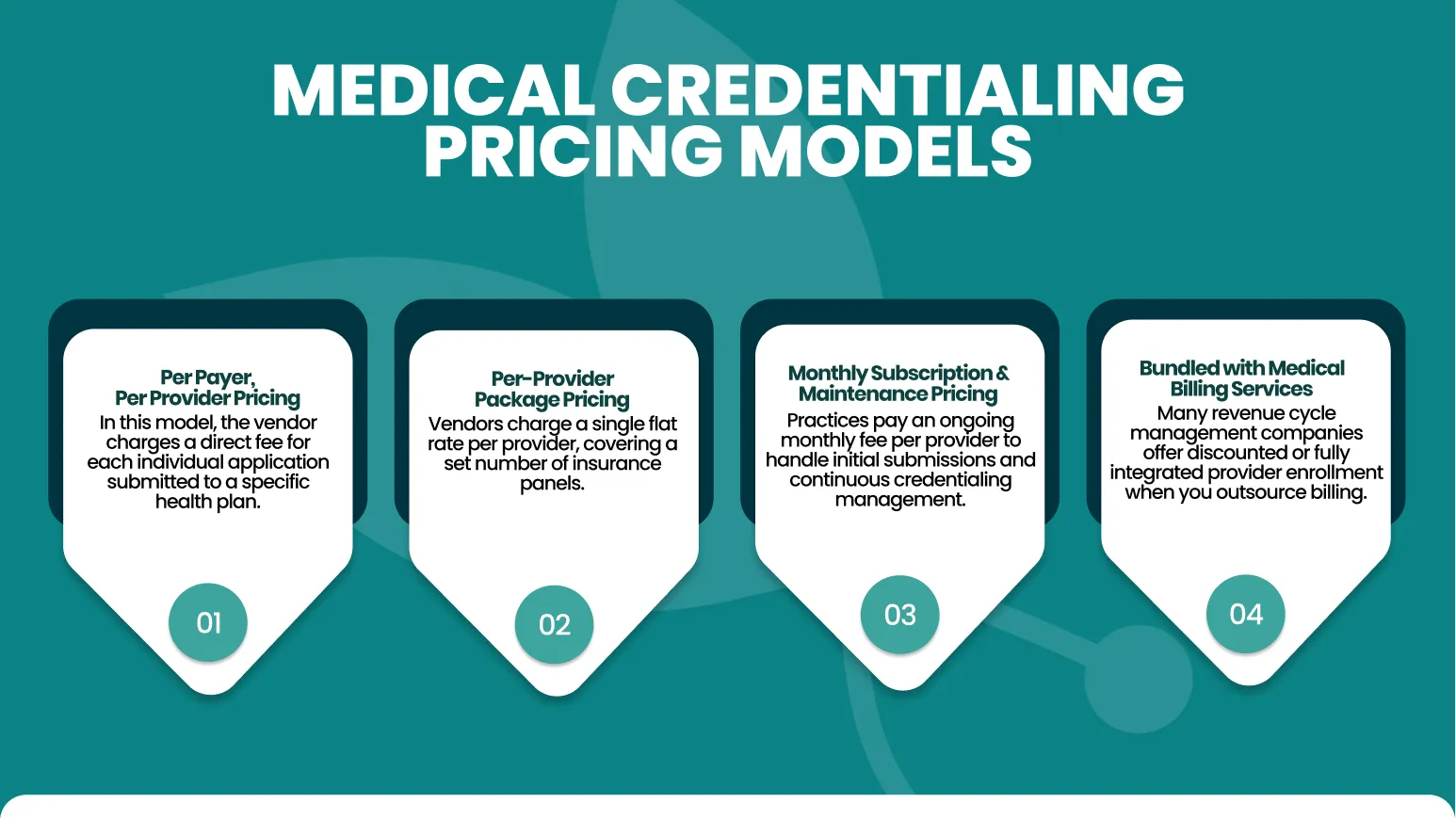
1. Per Payer, Per Provider Pricing
In this model, the vendor charges a direct fee for each individual application submitted to a specific health plan.
- Priced as: Fixed fee per application (e.g., $150 to $300 per payer).
- Best fit: Practices enrolling 1 or 2 providers with a small list of commercial payers.
- What to confirm: Verify whether primary source verification and application re-submissions are included if errors occur.
- Where it gets expensive: Costs escalate quickly when adding multi-state practices or expanding payer lists.
2. Per-Provider Package Pricing
Vendors charge a single flat rate per provider, covering a set number of insurance panels.
- Priced as: Lump sum per clinician (e.g., $1,000 to $2,000 for up to 10 payers).
- Best fit: New practices onboarding clinicians who need immediate, full-panel commercial and government enrollment.
- What to confirm: Check if unused payer slots roll over or expire, and ask about fees for additional payers beyond the cap.
- Where it gets expensive: Becomes inefficient if a provider only needs enrollment with 2 or 3 specific plans.
3. Monthly Subscription & Maintenance Pricing
Practices pay an ongoing monthly fee per provider to handle initial submissions and continuous credentialing management.
- Priced as: Recurring monthly fee (e.g., $100 to $250 per month per provider).
- Best fit: Larger medical groups with high provider turnover, frequent hospital privileging, and ongoing re-credentialing needs.
- What to confirm: Verify contract commitment lengths and cancellation terms.
- Where it gets expensive: Costs add up if onboarding slows down or if the practice maintains a stable provider list that rarely requires new applications.
4. Bundled with Medical Billing Services
Many revenue cycle management companies offer discounted or fully integrated provider enrollment when you outsource billing.
- Priced as: Discounted per-payer rate or bundled directly into the billing collection percentage.
- Best fit: Practices seeking consolidated administrative oversight across billing, coding, and enrollment.
- What to confirm: Clarify what happens to active credentialing applications if you terminate the billing agreement. For details, review our full provider credentialing services and options.
- Where it gets expensive: Unbundling fees may apply if credentialing is canceled while keeping billing services, or vice versa.
What a Credentialing Quote Should Actually Cover
A comprehensive proposal must detail the operational scope of work. When conducting a credentialing services pricing comparison, ensure the quote includes:
- CAQH ProView Profile Management: Setting up the initial profile, uploading required documentation, and executing mandatory re-attestations every 120 days (or 180 days in select states like Illinois per CAQH guidelines). Review what is CAQH credentialing for compliance rules.
- Medicare Enrollment (PECOS): Completing CMS-855A, 855B, or 855I applications through the Provider Enrollment, Chain, and Ownership System (PECOS), alongside managing required revalidations.
- State Medicaid Enrollment: Navigating state-specific Medicaid portals, including enrollment with Medicaid Managed Care Organizations (MCOs).
- Primary Source Verification (PSV): Verifying medical licenses, DEA registrations, board certifications, educational history, and malpractice coverage against primary sources.
- Recredentialing & Revalidation: Managing the NCQA-mandated re-credentialing cycle, which occurs at least once every 36 months.
- Network Follow-Up: Conducting regular outreach to insurance network managers until final contract execution.
For detailed California specific regulatory costs and state guidelines, consult our guide on credentialing costs in California.
12 Questions to Ask Before Signing a Proposal
- What is the specific credentialing cost per payer application under this proposal?
- Are CAQH ProView setup and 120-day re-attestation maintenance included?
- Does the proposal cover Medicare PECOS and state Medicaid enrollment?
- Are primary source verification costs included in the base price?
- How frequently will your team provide status updates on pending applications?
- Is re-credentialing every 36 months included, or billed separately?
- What happens if a payer rejects an application due to a closed panel?
- Are there initial setup, onboarding, or software implementation fees?
- Does the agreement include fee schedule review or contract rate negotiation?
- Who owns the credentialing documentation and CAQH logins if we terminate services?
- What is the precise contract term, and what notice is required to cancel?
- Do you offer reduced pricing if we bundle credentialing with medical billing services?
Red Flags to Avoid
- Guaranteed Turnaround Timelines: Vendors cannot control internal insurance company processing speeds.
- Vague Overhead Pricing: Quotes that group all fees under a generic administrative header without detailing per-payer breakdowns.
- Withheld Logins: Vendors that refuse to grant practices full access to their CAQH, PECOS, or NPPES profiles.
Frequently Asked Questions
Do I pay if a payer denies my application or the panel is closed?
It depends on the agreement. Some vendors charge their standard per-payer fee for processing the submission regardless of outcome, while others offer credit or appeal support if a panel is closed.
Is CAQH maintenance included in most credentialing quotes?
Not always. Many lower-cost proposals cover initial profile creation but charge extra for ongoing 120-day re-attestations and document updates.
How long does medical credentialing take?
Payer credentialing typically takes between 90 and 180 days. Turnaround times depend entirely on individual insurance company processing speeds and board review schedules.
Can I credential myself instead of paying a company?
Yes. Practice owners can complete applications directly through CAQH ProView, PECOS, and individual payer portals. However, self-credentialing requires significant time and regular follow-up to prevent administrative delays. Learn more in our guide on how to get credentialed with insurance companies.
Should credentialing and billing come from the same vendor?
Using a single vendor for both billing and credentialing ensures tighter alignment between provider enrollment dates and claim submissions, helping reduce initial claim denials.
Also read
Normalizing proposals into a single cost per application helps your practice make an informed, cost-effective decision. Explore our dedicated provider credentialing services to see how GreenSense Billing can streamline your provider enrollment process.
Sources


More Related Posts

-

November 4, 2026
Billing GuidesBest Medical Billing Companies for Psychiatry
The best medical billing companies for psychiatry — GreenSense Billing, Practolytics, MedCare MSO, OmniMD and PGM Billing — compared on pres...
-

November 3, 2026
Billing GuidesICD-10 Codes for Depression: F32 vs F33 Explained
F32 codes a single depressive episode; F33 codes recurrent major depressive disorder. Neither category is billable alone — choose the comple...
-

November 2, 2026
Billing GuidesICD-10 Code F41.1: Generalized Anxiety Disorder
F41.1 is the billable FY2027 ICD-10-CM code for generalized anxiety disorder. Use it when the provider documents generalized anxiety disorde...
-

October 30, 2026
Billing GuidesICD-10 Code F41.9: Anxiety Disorder, Unspecified
F41.9 is a billable FY2027 ICD-10-CM code for anxiety disorder, unspecified — but it is not a default. Use it only when the provider documen...
-
October 29, 2026
Billing GuidesICD-10 Code F33.1: Major Depressive Disorder, Recurrent, Moderate
F33.1 is a billable FY2027 ICD-10-CM code for major depressive disorder, recurrent, moderate. Use it when the provider documents a recurrent...
-

October 26, 2026
Billing GuidesICD-10 Codes for Mental Health Disorders: 2027 Coding Guide
Mental health diagnoses use ICD-10-CM Chapter 5 codes (F01-F99). This FY2027 guide covers the block map, billable vs header codes, and a pre...
-

October 21, 2026
Billing GuidesG43.909 ICD-10 Code: Migraine Coding Guide
Learn what G43.909 means, which migraine details matter and how related codes differ. Use a practical documentation checklist before claim s...
-

October 20, 2026
Billing GuidesE11 ICD-10 Codes: Type 2 Diabetes Coding Guide
Understand the E11 code family for type 2 diabetes. Compare common subcodes, documentation needs and additional-code checks before submittin...
-

October 19, 2026
Billing GuidesE66 ICD-10 Codes: Obesity Coding and BMI Documentation
E66 ICD-10 codes: obesity subcodes, BMI documentation, and pre-claim checks for cleaner claims.
-

October 16, 2026
Billing GuidesJ09.X2 ICD-10 Code: Meaning and Coding Guidance
Understand J09.X2, its influenza coding context and documentation checks. Compare related codes and review common errors before submitting a...
-

October 15, 2026
Billing GuidesICD-10 Codes: A Practical Guide for Medical Groups
Learn how ICD-10 codes support documentation, claims and practice workflows. Explore common coding errors and a practical checklist for medi...