

Introduction
Healthcare providers often struggle to decide whether to manage billing internally or outsource it, especially as administrative complexity increases. Many practices seek a reliable medical billing company near them to simplify operations.
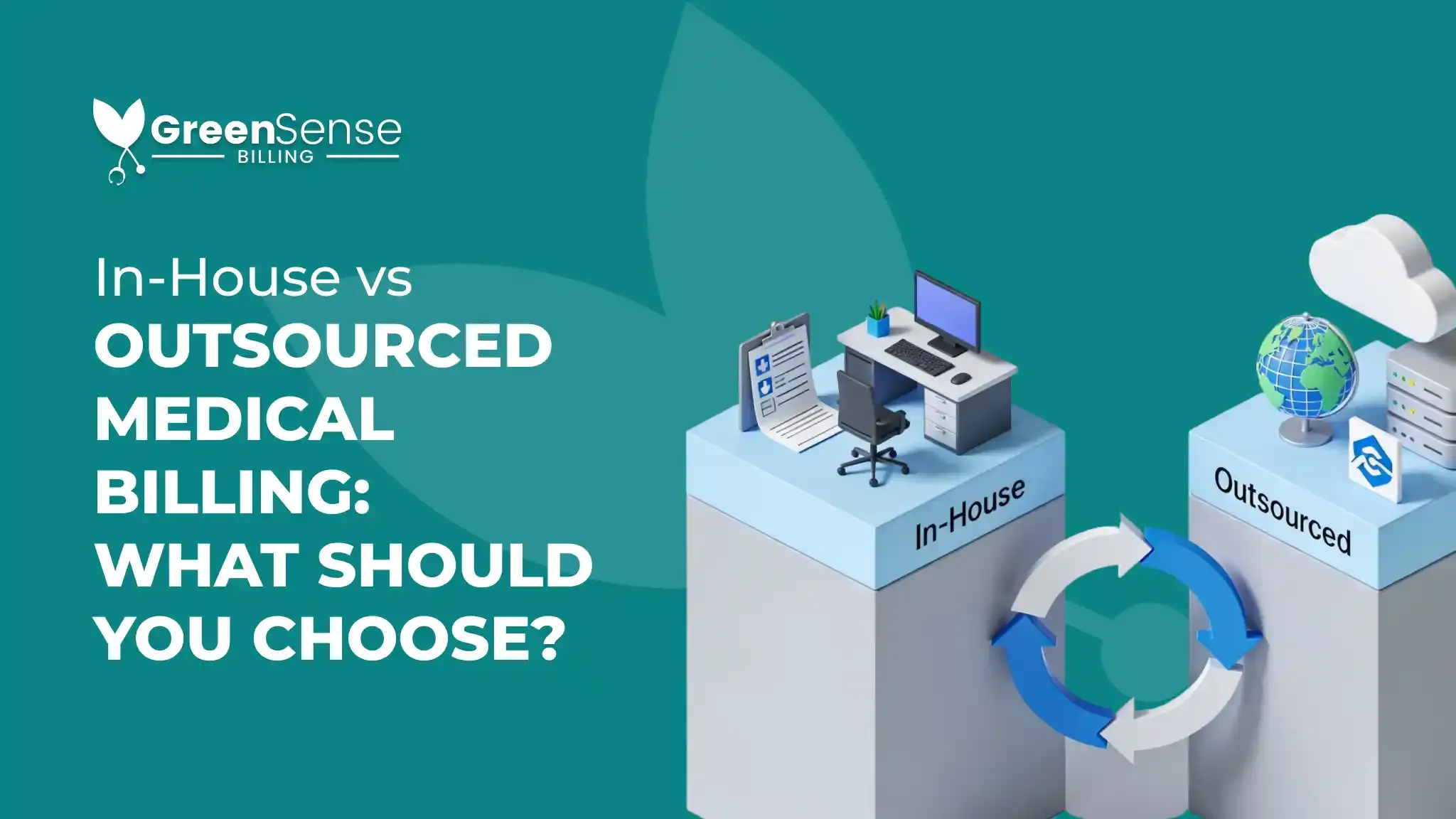
This article compares in-house medical billing and outsourced medical billing to help providers make an informed decision.
Readers will learn:
- How in-house billing works
- How outsourcing works
- Key differences in cost, control, and efficiency
- Which option fits different practice types
What is in-house medical billing?
In-house medical billing refers to managing billing processes within the practice using internal staff and systems.
In this model, the practice handles all billing activities internally, including insurance verification, coding, claim submission, payment posting, and follow-ups. The team works directly within the organization, using internal tools and processes to manage the revenue cycle.
This approach gives providers direct control over billing operations, but it also requires dedicated staff, ongoing training, and management oversight to maintain accuracy and consistency.
What is outsourced medical billing?
Outsourced medical billing involves hiring an external service provider to manage billing, claims, and revenue cycle processes.
Instead of handling billing internally, the practice relies on a specialized team that manages the entire workflow, from claim submission to follow-ups and payment tracking. This reduces the need for in-house staff and infrastructure while ensuring structured billing operations.
To understand how this works in detail, you can review this.
What are the key differences between in-house and outsourced billing?
The key differences between in-house and outsourced billing include cost structure, operational control, efficiency, and scalability.
Cost
In-house billing involves salaries, software, training, and administrative overhead. Outsourcing typically follows a predictable pricing model, often based on collections.
Staffing
In-house requires hiring, training, and managing a billing team. Outsourcing removes the need for internal billing staff.
Control
In-house offers direct control over processes. Outsourcing shifts execution to an external team while maintaining visibility into reporting.
Efficiency
Outsourced billing teams focus solely on billing processes, often improving speed and reducing delays.
Risk
In-house billing carries risks, such as staff turnover and inconsistent performance. Outsourcing reduces dependency on internal resources.
Which option is more cost-effective?
Outsourced medical billing is often more cost-effective for small to mid-sized practices, while in-house billing may suit larger organizations with established teams.
In-house billing may seem cost-effective at first, but hidden expenses such as salaries, benefits, software, and training can add up. Outsourcing provides a more predictable cost structure, allowing practices to better manage expenses and focus on patient care.
How does outsourcing impact efficiency and accuracy?
Outsourcing improves efficiency and accuracy by using specialized teams and structured workflows focused on billing performance.
Experienced billing professionals follow updated payer guidelines, coding standards, and compliance requirements. This reduces claim errors, speeds up processing, and improves reimbursement outcomes.
You can also explore how structured billing improves performance.
How should a practice decide between in-house and outsourced billing?
A practice should decide between in-house and outsourced billing based on workload, budget, growth plans, and internal capabilities.
Small practices often benefit from outsourcing due to limited resources and staffing. Growing practices may adopt outsourcing or hybrid models to handle increased billing complexity. Larger practices may keep billing in-house if they have strong internal systems, although outsourcing can still improve efficiency.
For a foundational understanding of billing workflows, review what medical billing services are.
Additional considerations before choosing a billing model
Before making a final decision, practices should evaluate several critical factors that are often overlooked.
One important factor is staff expertise. Billing requires constant updates on coding rules and payer requirements. If your team struggles to keep up with these changes, errors can increase quickly.
Another factor is scalability. As patient volume grows, billing complexity increases. In-house teams may struggle to keep up without additional hiring, while outsourced teams are already equipped to scale.
Technology also plays a key role. In-house billing depends on your internal systems, which may require frequent updates and maintenance. Outsourced providers typically use advanced tools designed specifically for billing efficiency.
Finally, consider the impact on patient experience. When billing is handled efficiently, patients face fewer delays, fewer billing errors, and better communication, which improves overall satisfaction.
FAQs
Is outsourced medical billing better than in-house?
It depends on practice size and needs. Outsourcing improves efficiency and reduces workload, while in-house offers more control.
What are the risks of in-house billing?
Risks include staff turnover, training gaps, errors, and inconsistent follow-ups that can impact revenue.
How much does outsourced billing cost?
It is usually based on a percentage of collections or a fixed fee, making it more predictable than in-house costs.
Can small practices outsource billing?
Yes, outsourcing is often ideal for small practices to reduce workload and improve efficiency.
Do outsourced billing services reduce errors?
Yes, they follow structured processes and experienced workflows to minimize billing errors and improve claim accuracy.
Conclusion
Choosing between in-house and outsourced medical billing depends on your practice size, resources, and operational goals. In-house billing offers control, while outsourcing provides efficiency, scalability, and reduced administrative burden.
For practices looking to improve billing performance and streamline operations, GreenSense Billing offers structured solutions designed to support long-term efficiency and accuracy. You can contact us today.
Many healthcare providers also rely on a trusted medical billing and coding company near me to maintain consistency and improve revenue cycle management.
