
Top 10 Medical Billing Companies in Texas to Outsource (2026)

Authored by Sara Williams on September 10, 2026 · 13 minutes read



Key Takeaways
- Texas practices outsource billing largely because Texas Medicaid’s managed care structure, BCBSTX’s market dominance, and the state’s non-expansion status create more payer complexity than most in-house teams can track well.
- The Texas Prompt Pay Act gives providers real leverage: state-regulated commercial HMO and PPO carriers must pay clean electronic claims within 30 days or face financial penalties, and a billing partner with strong clean-claim processes can use that law to your advantage.
-
Texas Medicaid runs through multiple competing MCOs, each with its own prior authorization rules and denial patterns, so RCM outsourcing Texas partners need documented MCO-specific experience, not general Medicaid familiarity, especially around denial management Texas practices rely on to keep revenue moving.
-
Outsourcing can meaningfully reduce total billing cost once salaries, benefits, software, and training are counted, though the exact savings range varies by source and practice size (see the cost section below for specifics and caveats). Practices looking for affordable medical billing Texas partners should compare total cost of collection, not just the advertised percentage.
-
What separates a good Texas billing partner from an average one usually comes down to documented BCBSTX and STAR MCO experience, a clear answer on full-service RCM versus billing-only scope, transparent reporting, and confirmed HIPAA compliant billing Texas practices can trust with patient data, not the lowest advertised percentage.
If you are a Texas physician weighing whether to hand billing to an outside partner, the decision comes down to a few concrete questions: does the medical billing company Texas vendors point to actually understand Texas Medicaid’s managed care structure, can it leverage state prompt-pay law when a claim runs late, and does its pricing actually beat what you are spending in-house once every cost is counted.
This guide compares 10 companies you could outsource medical billing Texas-wide to, including GreenSense Billing, on the same criteria: services, Texas payer experience, outsourcing model, and pricing. Whether you are searching for third party medical billing Texas options as a solo practitioner or comparing medical billing outsourcing companies Texas for a larger group, the goal is to help you find the best medical billing company to outsource in Texas for your practice, not to declare a single winner.
Quick Comparison Table
Best for at a glance (based on the specialty focus and evidence each company publishes, not an independent ranking):
- Best for Texas Medicaid (STAR) Billing: Medical Billers and Coders (MBC), the only company reviewed that publishes specific language about MCO-level authorization workflows
- Best for Small/Solo Texas Practices: GreenSense Billing
- Best for Full-Service RCM Outsourcing: R1 RCM, for large groups and health systems; GreenSense Billing, for independent and small practices
- Best for Behavioral Health Billing Texas: Plutus Health, based on its stated behavioral health and ASC/surgical billing focus
- Best for Rural Texas Practices: Not clearly stated by any company reviewed; confirm border-region and FQHC billing experience directly before assuming coverage
- Best Overall for Texas Outsourcing: Not clearly stated; no company in this comparison publishes evidence strong enough across every criterion to justify that label
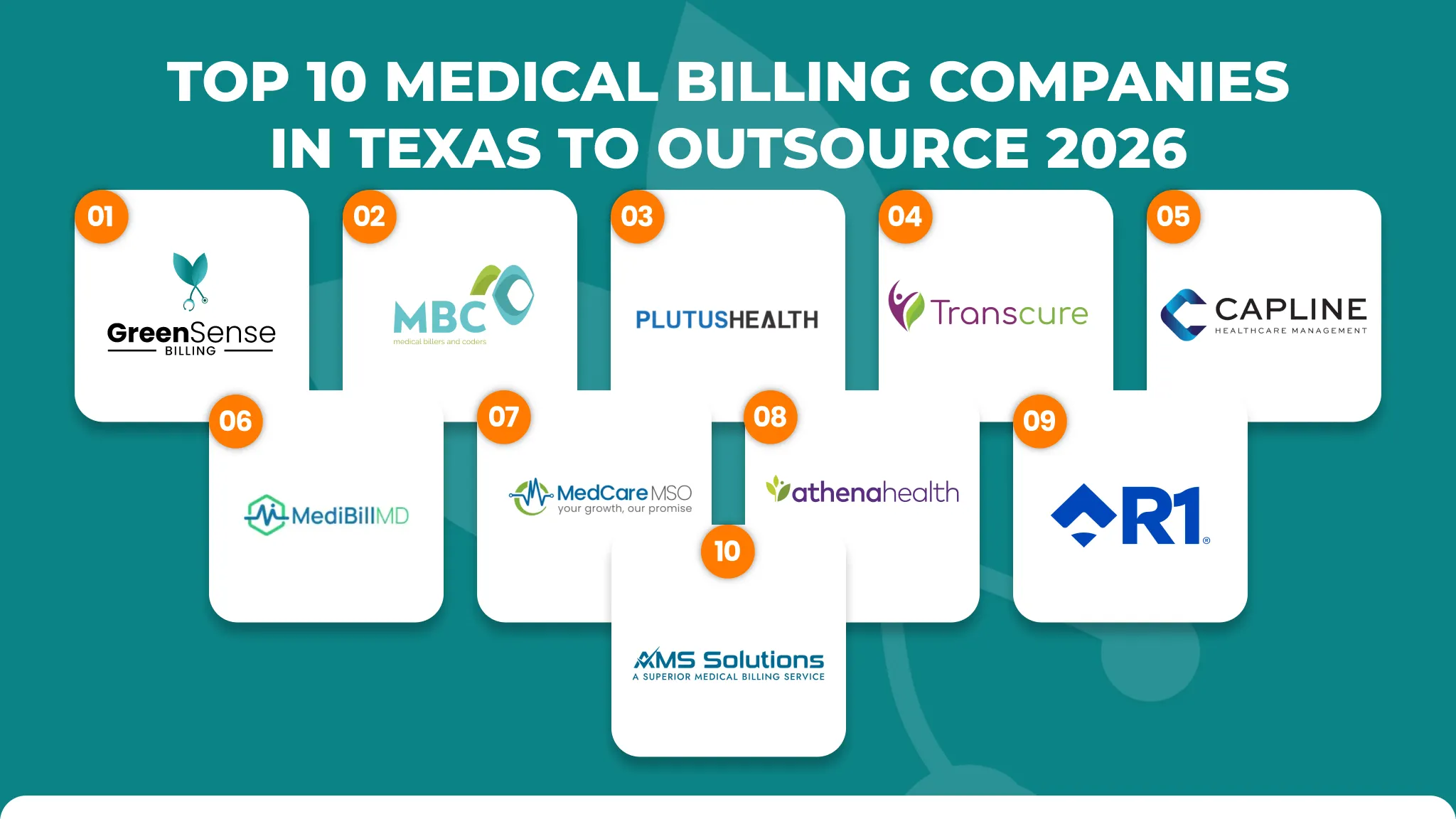
|
Company |
Best For |
Location |
Core Services |
Texas Medicaid/MCO |
Payer Support |
Pricing Model |
Evidence / Source |
|
GreenSense Billing |
Small and mid-size Texas practices |
Serving Texas statewide |
Medical billing, coding, credentialing, denial management, eligibility verification |
States its team understands Texas payer systems and regulations |
Documented Texas payer familiarity |
Percentage of collections, no upfront fees |
https://greensensebilling.com/location/medical-billing-services-in-texas/ |
|
Plutus Health |
Behavioral health and ASC billing |
Dallas, TX |
Coding, billing, payment posting, denial management, credentialing, AR follow-up |
Not clearly stated |
Behavioral health, ASC/surgical, free-standing ER payers |
Percentage of collections |
|
|
Transcure |
Multi-specialty billing with in-house tech |
Dallas, TX and Woodbridge, NJ |
Billing, coding, denial management, credentialing, EHR integration |
Not clearly stated |
Aetna, UnitedHealthcare, Medicare |
Not clearly stated |
|
|
Capline Healthcare Management |
Billing and credentialing together |
Houston, TX |
Billing, credentialing, eligibility verification, denial management |
Not clearly stated |
Commercial payers, Medicaid |
Not clearly stated |
|
|
MediBillMD |
Small to mid-size Texas practices |
Dallas, TX |
Billing, coding, RCM, credentialing |
Not clearly stated |
BCBS, Cigna, Medicaid, Medicare |
Not clearly stated |
|
|
MedCare MSO |
Labs, imaging centers, hospitals |
US-based, serves Texas |
Billing, coding, AR recovery, healthcare data integration |
Not clearly stated |
Not clearly stated |
Not clearly stated |
|
|
AMS Solutions |
Long-standing, transparent pricing |
Dallas, TX |
Billing, AR collections, credentialing, practice management |
Not clearly stated |
Not clearly stated |
Flat percentage of collections |
|
|
Athenahealth |
Practices on the athenahealth platform |
National, serving Texas |
EHR-integrated billing, claims management |
Not clearly stated |
Broad commercial payer network |
Not clearly stated |
|
|
R1 RCM |
Hospitals and large physician groups |
Murray, UT, offices in Texas |
End-to-end RCM, patient access, denial resolution, AI automation |
Not clearly stated |
Broad payer mix at enterprise scale |
Not clearly stated |
|
|
Medical Billers and Coders (MBC) |
Documented Texas MCO workflows |
National, serving Texas |
Billing, coding, denial management, credentialing |
States documented MCO-specific workflows |
BCBSTX, commercial payers |
Not clearly stated |
Company order groups national/enterprise players first, then Texas-based specialists, and is not a ranking. See the methodology note in the FAQ section below.
Why Outsourcing Medical Billing in Texas Makes Sense in 2026
Texas has a few specific, verifiable factors that make outsourced billing more valuable here than in a lot of other states.
The Texas Prompt Pay Act. Under Texas Insurance Code Chapters 843 and 1301, state-regulated commercial HMO and PPO carriers must pay a clean electronic claim within 30 days of receipt, or 45 days for a paper claim, and carriers that miss the deadline owe a penalty. This protection applies specifically to state-regulated commercial plans, not to Medicare, not to self-funded ERISA employer plans, and not to Texas Medicaid managed care, which has its own separate prompt-pay terms under HHSC. A billing partner with disciplined clean-claim submission is positioned to use this law to your advantage on the plans it actually covers.
Texas Medicaid STAR MCO complexity. Texas Medicaid runs through competing managed care organizations, including Molina Healthcare, BCBS of Texas, UnitedHealthcare Community Plan, Superior HealthPlan (Centene), and Aetna Better Health of Texas, among others. Each MCO sets its own prior authorization rules, denial patterns, and timelines, so a billing company needs documented, MCO-specific experience rather than general Medicaid familiarity. Confirm the current active MCO list directly withTexas HHSC, since it can change.
Rising denial rates. According to Kodiak Solutions revenue cycle data covering more than 2,100 hospitals and 300,000 physicians, the national initial claim denial rate rose to 11.81% in 2024, up from roughly 10.2% in 2020, with Medicare Advantage-related denials contributing significantly to the increase. Texas practices navigating MCO fragmentation on top of this national trend face compounded denial risk, which is part of why documented denial management capability matters more here than in simpler payer markets.
BCBSTX dominance. Blue Cross Blue Shield of Texas is the largest commercial insurer in the state. Any billing partner serving Texas practices should be able to point to specific, documented BCBSTX claim experience.
Non-Medicaid-expansion state. Texas has not expanded Medicaid under the ACA, which means a higher proportion of uninsured, self-pay patients than in expansion states. Billing companies serving Texas need strong self-pay and patient collections processes, not just payer claim submission.
The cost case for outsourcing. Industry sources report that eliminating in-house billing salaries, benefits, software, and training typically saves practices somewhere in the range of 25 to 40 percent compared to managing billing internally, once every cost is counted rather than just the biller’s salary line. This figure appears consistently across multiple industry billing and RCM sources, though none of them point to a single independent, peer-reviewed study behind the number, so treat it as a directionally useful industry-reported range rather than an audited statistic, and run your own practice’s numbers before assuming it applies to you.
Texas market scale. Texas has more than 630 hospitals and over 400,000 healthcare employees, generating an estimated $144 billion in annual hospital economic activity. At that scale, the choice of billing partner is a high-stakes decision, not a commodity purchase.
Rural and border region context. Rural West Texas and South Texas border regions carry distinct billing challenges, including higher Medicaid volumes, Federally Qualified Health Center (FQHC) billing rules under the Prospective Payment System, and provider shortage context. Not every billing company documents specific experience here, so ask directly rather than assume.
Items not clearly documented in public sources are marked “Not clearly stated” throughout this guide rather than assumed.
GreenSense Billing
- Best for: Small and mid-size Texas practices wanting a hands-on billing partner
- Location: Serving Texas statewide
- Core services: GreenSense Billing offers medical billing as its core service, backed by revenue cycle management, medical coding, and provider credentialing
- Payer expertise: States its team understands Texas payer systems and regulations, including requirements outlined by the Texas Department of Insurance
- Provider types served: Private clinics, multi-specialty groups, ambulatory care centers
- Specialties supported: States support across more than 25 medical specialties
- Texas Medicaid/MCO experience: Not clearly stated beyond general Texas payer system familiarity
- Outsourcing model: Full-service RCM, covering eligibility verification through denial management and accounts receivable management
- Why it made the list: Operates a dedicated Texas services page, offers a percentage-of-collections pricing model with no upfront costs, and positions itself specifically as a medical billing for small practices Texas partner rather than an enterprise health system vendor
Medical Billers and Coders (MBC)
- Best for: Documented Texas MCO-specific billing workflows
- Location: National, serving Texas
- Core services: Billing, coding, denial management, provider credentialing
- Payer expertise: States documented experience with BCBSTX and Texas Medicaid MCOs
- Provider types served: Solo practitioners through large physician groups
- Specialties supported: Orthopedics, cardiology, pain management, among others
- Texas Medicaid/MCO experience: States it maintains MCO-specific authorization workflows
- Outsourcing model: Full-service RCM
- Why it made the list: Publishes specific, evidence-based claims about Texas MCO-level billing rather than generic RCM messaging
Plutus Health
- Best for: Behavioral health and ASC/surgical billing outsourcing
- Location: Dallas, Texas
- Core services: Coding, billing, payment posting, denial management, credentialing, prior authorizations, AR follow-up
- Payer expertise: Behavioral health, ASC/surgical, and free-standing ER billing
- Provider types served: States it works with more than 9,000 providers
- Specialties supported: Behavioral health, ASC/surgical, free-standing emergency room
- Texas Medicaid/MCO experience: Not clearly stated
- Outsourcing model: Full-service RCM, built around a named proprietary automation platform
- Why it made the list: Dallas-headquartered with a documented, named automation platform and a stated outcome-based commercial model
Denial management is where Texas practices most often lose ground, since MCO-specific appeal timelines vary. GreenSense Billing’s denial management services are built around that kind of payer-specific follow-up.
Transcure
- Best for: Multi-specialty practices wanting in-house billing technology
- Location: Dallas, Texas and Woodbridge, New Jersey
- Core services: Billing, coding, denial management, credentialing, EHR integration
- Payer expertise: States it files claims with Aetna, UnitedHealthcare, and Medicare
- Provider types served: Solo practices through hospitals
- Specialties supported: States more than 40 specialties
- Texas Medicaid/MCO experience: Not clearly stated
- Outsourcing model: Full-service RCM with proprietary technology and EHR integration
- Why it made the list: Maintains a documented Dallas office and publishes specific claim-filing and AR-day figures on its own site
Capline Healthcare Management
- Best for: Billing and credentialing under one roof
- Location: Houston, Texas
- Core services: Billing, credentialing, eligibility verification, denial management, IT support
- Payer expertise: Not clearly stated beyond general commercial and Medicaid claim handling
- Provider types served: Medical and dental practices
- Specialties supported: Not clearly stated
- Texas Medicaid/MCO experience: Not clearly stated
- Outsourcing model: Full-service, combining billing with credentialing and eligibility verification
- Why it made the list: Houston-headquartered, founded in 2016, with a documented focus on combined billing, credentialing, and eligibility verification
For practices weighing whether to keep credentialing in-house when they switch billing partners, GreenSense Billing’s provider credentialing services page walks through what a full-service credentialing workflow looks like.
MediBillMD
- Best for: Small to mid-size Texas practices
- Location: Dallas, Texas
- Core services: Billing, coding, revenue cycle management, credentialing
- Payer expertise: Not clearly stated beyond general commercial and Medicaid claim handling
- Provider types served: Physicians, nurse practitioners, group practices
- Specialties supported: States coverage across dozens of specialties
- Texas Medicaid/MCO experience: Not clearly stated
- Outsourcing model: Full-service RCM, combining billing with credentialing and coding
- Why it made the list: Dallas-headquartered, founded in 2023, with a stated focus on Texas-based practices
MedCare MSO
- Best for: Labs, imaging centers, and hospital billing
- Location: US-based, serving Texas practices
- Core services: Billing, coding, AR recovery, healthcare data integration
- Payer expertise: Not clearly stated
- Provider types served: Labs, imaging centers, hospitals, physician practices
- Specialties supported: States more than 50 clinical specialties
- Texas Medicaid/MCO experience: Not clearly stated
- Outsourcing model: Full-service RCM
- Why it made the list: Publishes a dedicated Texas billing page and states specific compliance credentials, including HIPAA and ISO 9001:2015
AMS Solutions
- Best for: A long-established Texas billing partner with transparent pricing
- Location: Dallas, Texas
- Core services: Billing, AR collections, credentialing, practice management
- Payer expertise: Not clearly stated
- Provider types served: Solo physicians through large group practices
- Specialties supported: States around 28 specialties, including anesthesia, plastic surgery, and pediatrics
- Texas Medicaid/MCO experience: Not clearly stated
- Outsourcing model: Full-service billing and practice management
- Why it made the list: One of the longest-operating billing companies in Dallas, founded in 1986, with a stated flat-percentage pricing model and no setup fees
Athenahealth
- Best for: Practices already using or considering athenahealth’s EHR platform
- Location: National, serving Texas
- Core services: EHR-integrated billing, claims management, revenue cycle services
- Payer expertise: Broad commercial payer network through its platform
- Provider types served: Practices of varying sizes on the athenahealth platform
- Specialties supported: Multiple specialties through platform-based workflows
- Texas Medicaid/MCO experience: Not clearly stated
- Outsourcing model: Billing delivered as part of an integrated EHR and practice management platform, not a standalone service
- Why it made the list: A nationally established, platform-based option for Texas practices that want billing tied directly to their EHR
R1 RCM
- Best for: Hospitals, health systems, and large physician groups
- Location: Headquartered in Murray, Utah, with offices in Texas
- Core services: End-to-end RCM, patient access, denial resolution, AI-driven automation
- Payer expertise: States it manages revenue cycle operations at enterprise scale across a broad payer mix
- Provider types served: Large health systems and hospital-owned or independent physician groups
- Specialties supported: Enterprise-wide, not specialty-specific
- Texas Medicaid/MCO experience: Not clearly stated
- Outsourcing model: Full-service RCM, including AI-assisted denial resolution
- Why it made the list: A large, publicly documented enterprise RCM vendor with offices in Texas and a stated multibillion-dollar managed revenue base
In-House vs. Outsourced Billing: Texas Cost Comparison
|
Factor |
In-House Billing |
Outsourced Billing |
|
Staffing burden |
Requires hiring, training, and retaining billing staff |
Handled by the billing partner’s team |
|
Cost structure |
Fixed salary, benefits, and software costs |
Often percentage-of-collections, scaling with revenue |
|
Reported savings potential |
Baseline |
Industry sources report roughly 25-40% lower total cost once salary, benefits, software, and training are counted, though this figure is not independently audited |
|
Texas payer complexity |
Requires internal staff to track STAR MCO and BCBSTX rule changes |
Billing partner absorbs the tracking and compliance burden |
|
Prompt Pay Act leverage |
Depends on internal team catching late payments manually |
A disciplined clean-claim process can trigger prompt-pay penalties automatically |
|
Scalability |
Harder to scale quickly with practice growth |
Easier to scale as claim volume changes |
How to Choose a Medical Billing Company to Outsource in Texas
Not every outsource medical billing services Texas vendor is built the same way, and the right fit depends on your practice’s size, specialty, and payer mix. Before signing with any partner, check these criteria:
- Texas MCO experience. Ask which specific Texas Medicaid MCOs (Molina, Superior HealthPlan, Amerigroup, and others) the company has documented experience with.
- BCBSTX familiarity. Given how much of the Texas commercial market runs through BCBSTX, this is not optional.
- Prompt Pay Act leverage. Ask how the company’s clean-claim process is structured to catch and act on late payments from state-regulated commercial plans.
- Full-service vs. billing-only. Confirm exactly which functions are included: coding, credentialing, eligibility verification, and denial management are not automatically bundled.
- Pricing model. Percentage-of-collections, flat fee, or hybrid models each carry different incentives.
- Denial management depth. Ask how denials are triaged, appealed, and tracked back to root cause; strong medical billing and coding Texas partners can point to specific denial-prevention workflows, not just resubmission speed.
- HIPAA and BAA. Confirm the vendor will sign a Business Associate Agreement before any patient data changes hands.
- EHR compatibility. Confirm the billing company works with your existing practice management system.
- Contract terms. Look for clarity on setup fees, minimum terms, and termination clauses.
If your current medical billing service Texas process is struggling with any of the criteria above, GreenSense Billing’s revenue cycle management services page walks through what a full revenue cycle management Texas handoff typically covers, so you can compare it against what you have in place now.
Sources
Frequently Asked Questions (FAQs)
What does outsourcing medical billing mean for a Texas practice?
It means contracting an external company to handle claim submission, denial management, and payment posting on your behalf, while your practice keeps clinical control. For Texas practices, this typically also means the vendor takes on tracking STAR MCO rules and BCBSTX-specific requirements.
How much does it cost to outsource medical billing in Texas?
Most vendors charge a percentage of collections. Industry sources report overall savings in the range of 25 to 40 percent compared to fully loaded in-house costs, though this figure varies by source and should not be treated as guaranteed for every practice.
What should a Texas practice look for in an outsourced billing company?
Documented Texas Medicaid MCO experience, BCBSTX familiarity, a clear answer on full-service versus billing-only scope, and a disciplined clean-claim process that can trigger Prompt Pay Act protections on eligible plans.
Does Texas Medicaid MCO complexity affect which billing company to choose?
Yes. Each MCO sets its own prior authorization rules and denial patterns, so a billing partner without documented, MCO-specific experience is more likely to see preventable denials on Texas Medicaid claims.
How does the Texas Prompt Pay Act benefit practices using outsourced billing?
State-regulated commercial HMO and PPO carriers must pay clean electronic claims within 30 days or face a penalty. A billing partner with strong clean-claim submission processes is positioned to catch and act on violations of this deadline on the plans it applies to.
Is outsourcing medical billing worth it for small Texas practices?
For many small practices, yes, given the administrative burden of tracking MCO-specific rules and payer updates that change often in Texas. The right decision still depends on your practice’s volume, staffing, and current denial rate.
How do I choose the best medical billing company to outsource in Texas?
Compare on Texas MCO experience, BCBSTX familiarity, Prompt Pay Act leverage, full-service versus billing-only scope, and pricing model, using the criteria in the “How to Choose” section above rather than rankings alone.
What percentage do Texas medical billing companies charge?
Pricing is not standardized across the industry; percentage-of-collections, flat-fee, and hybrid models all appear among the companies in this comparison. Confirm exact rates directly with each vendor.
How does Texas Medicaid MCO billing work when outsourced?
The billing company submits and follows up on claims according to each specific MCO’s prior authorization and documentation rules, which can differ meaningfully between Molina, Superior HealthPlan, and other Texas Medicaid MCOs.
How long does it take to transition to an outsourced billing company in Texas?
Transition timelines are not standardized and depend on practice size, EHR compatibility, and how much historical AR needs to be migrated. Confirm an estimated timeline directly with any vendor you evaluate.
Does outsourcing medical billing affect patient relationships?
It can affect patient billing communication if not managed carefully, since the vendor typically handles patient statements and collections calls. Ask how a prospective partner handles patient-facing communication before signing.
What should be in a Texas medical billing outsourcing contract?
Clarity on pricing structure, contract length, termination terms, what happens to unresolved claims if you switch vendors, and confirmation of a signed BAA before any patient data is shared.
If your Texas practice is dealing with denials, aging AR, or the administrative weight of tracking STAR MCO rules in-house, GreenSense Billing’smedical billing team can review your current setup and show you where a Texas-focused outsourcing partner could help.


More Related Posts

-

October 20, 2026
Billing GuidesE11 ICD-10 Codes: Type 2 Diabetes Coding Guide
Understand the E11 code family for type 2 diabetes. Compare common subcodes, documentation needs and additional-code checks before submittin...
-

October 19, 2026
Billing GuidesE66 ICD-10 Codes: Obesity Coding and BMI Documentation
E66 ICD-10 codes: obesity subcodes, BMI documentation, and pre-claim checks for cleaner claims.
-

October 16, 2026
Billing GuidesJ09.X2 ICD-10 Code: Meaning and Coding Guidance
Understand J09.X2, its influenza coding context and documentation checks. Compare related codes and review common errors before submitting a...
-

October 15, 2026
Billing GuidesICD-10 Codes: A Practical Guide for Medical Groups
Learn how ICD-10 codes support documentation, claims and practice workflows. Explore common coding errors and a practical checklist for medi...
-

October 7, 2026
Billing GuidesTop 5 Medical Credentialing Companies in Illinois (2026)
Compare 5 medical credentialing companies serving Illinois. Verified turnarounds, payer coverage, pricing and IDFPR licensing lead times.
-

-

October 2, 2026
Billing GuidesTop 5 Medical Credentialing Companies in Florida (2026)
Compare the top medical credentialing companies in Florida for 2026: services, turnaround times, pricing, and the AHCA deadlines that shape...
-

October 1, 2026
Billing GuidesTop 5 Medical Credentialing Companies in Texas for 2026
Compare five medical credentialing companies in Texas on services, turnaround, payers, and accreditation, plus the Texas rules (TSCA, PEMS,...
-

September 25, 2026
Billing GuidesBest Medical Credentialing Companies in the USA (2026)
Compare the top medical credentialing companies in the USA for 2026: turnaround times, payer networks, and pricing, so you can pick the righ...
-

September 24, 2026
Billing GuidesCost of Medical Credentialing in California in 2026
Learn the 2026 cost of medical credentialing in California, including payer enrollment, CAQH, Medicare, Medi-Cal, licensing, and ongoing fee...
-

September 23, 2026
Billing GuidesTop 7 Medical Credentialing Services for California (2026)
Navigate California's Medi-Cal, HMO, and commercial credentialing. Compare the top 7 medical credentialing services for California practices...
-

September 22, 2026
Billing GuidesTop 5 Medical Credentialing Companies in California (2026)
Compare the top 5 medical credentialing companies in California for 2026 — ranked by Medi-Cal MCO experience, turnaround time, specialty cov...