
E11 ICD-10 Codes: Type 2 Diabetes Coding Guide

Authored by Sara Williams on October 20, 2026 · 8 minutes read



Key Takeaways
- E11 is a non-billable parent header Category E11 covers Type 2 diabetes mellitus, but it is a non-billable parent header — claims must use a complete subcode such as E11.9 or E11.65.
- The "with" presumption links diabetes to complications The ICD-10-CM "with" presumption links diabetes to CKD, neuropathy, retinopathy and foot ulcers unless the provider documents another cause.
- Combination codes need their partners Combination codes need their partners: E11.22 requires an N18 code for the CKD stage, and E11.621 requires an L97 code for ulcer site and severity.
- Insulin use does not mean Type 1 diabetes Insulin use does not mean Type 1 diabetes — report Z79.4 for long-term insulin or Z79.84 for oral hypoglycemics alongside the E11 code.
- Multiple E11 codes can be reported together Patients with several complications can carry multiple E11 codes at once, one for each documented manifestation.
When managing clinical documentation for diabetic patients, coders frequently encounter category E11. Selecting E11 ICD-10 codes requires expanding beyond the generic three-character heading. Category E11 is not a valid, reportable claim code by itself; it represents a parent category that demands a specific subcode to report clinical complications, manifestations, or control status.
Note that writing "E11*" in documentation is simply code-family shorthand, not a literal reportable claim code.
Quick answer: E11 alone is never billable. Report a complete Type 2 diabetes subcode (such as E11.9, E11.65, E11.22, E11.42, or E11.621), and add Z79.4 or Z79.84 when long-term insulin or oral hypoglycemic use is documented.
What Does E11 Mean?
According to the official CMS and CDC ICD-10-CM Tabular List, category E11 represents Type 2 diabetes mellitus. This category includes diabetes described as adult-onset, non-insulin dependent, or maturity-onset.
Because E11 is an unbillable category header, submitting a claim with only three characters causes billing edits, rejections, and unnecessary administrative delays. Establishing robust denial management protocols helps billing teams identify these incomplete parent headers before claims are submitted to payers. Coders must identify the appropriate fourth, fifth, or sixth characters supported by provider documentation.
| Field | Detail |
|---|---|
| ICD-10-CM Category | E11 |
| Category Title | Type 2 diabetes mellitus |
| Block & Section | Endocrine, Nutritional and Metabolic Diseases (E00–E89) |
| Code Status | Non-billable parent header (requires subcodes for specific manifestations) |
| Instructional Notes | Use additional code to identify control status, long-term insulin use (Z79.4), or long-term oral hypoglycemic use (Z79.84). |
| Claim-Use Caveat | Requires documented clinical correlation for specific organ manifestations and complications. |
Common E11 Subcodes Compared
Selecting the correct subcode within the E11 category requires careful evaluation of provider clinical notes. Understanding the clinical distinctions between codes, such as comparing E10 vs E11 entries for Type 1 versus Type 2 diabetes, is fundamental to accurate charge capture.
The table below outlines key subcodes commonly used in medical billing, as detailed in resources such as the AAPC E11 Code Guide.
| Code | Meaning | Required Documentation | Additional-Code Check |
|---|---|---|---|
| E11.9 | Type 2 diabetes mellitus without complications | Provider diagnosis of Type 2 diabetes with no stated complications | Add long-term medication codes (Z79.4, Z79.84) if applicable. |
| E11.65 | Type 2 diabetes mellitus with hyperglycemia | Explicit clinical note stating "hyperglycemia" or "uncontrolled" diabetes | Verify if secondary acute complications like ketoacidosis exist. |
| E11.22 | Type 2 diabetes mellitus with diabetic chronic kidney disease | Provider documentation linking Type 2 diabetes to CKD | Code also the specific stage of CKD from category N18. |
| E11.42 | Type 2 diabetes mellitus with diabetic polyneuropathy | Clinical record establishing diabetic polyneuropathy or peripheral neuropathy | Check for related lower extremity manifestations or skin ulcers. |
| E11.621 | Type 2 diabetes mellitus with foot ulcer | Documented diabetic foot ulcer with specified location | Code also the site and severity of the foot ulcer (category L97). |
Documenting Diabetes and Complications
Accurate reporting relies on understanding Section I.C.4.a of the official ICD-10-CM Guidelines.
Provider Documentation Requirements
The provider must establish the specific type of diabetes. When the documentation fails to specify the type but confirms diabetes mellitus, the default code selection in ICD-10-CM is category E11 (Type 2 diabetes).
The "With" Presumption
In the ICD-10-CM Alphabetic Index and Tabular List, the word "with" links diabetes to conditions like chronic kidney disease, neuropathy, retinopathy, and foot ulcers. These conditions are presumed to be related to diabetes unless the provider explicitly states another cause. However, coders must still confirm that both conditions are documented before applying combination codes.
Combination and Additional Codes
ICD-10-CM uses combination coding extensively for Type 2 diabetes to pair the underlying disease with organ manifestations.
- Multiple Manifestations: A patient can have multiple diabetic complications simultaneously. Assign as many codes from category E11 as necessary to describe all documented complications (for instance, reporting both E11.22 for renal manifestations and E11.42 for neurological manifestations).
- Secondary Condition Codes: Combination codes often require secondary entries. When coding E11.22, assign a secondary code from category N18 to specify the Chronic Kidney Disease stage. When reporting a severe vascular or integumentary breakdown using E11.621, assign a secondary code from category L97 to describe the ulcer site and depth.
- Long-Term Medication Status: Do not infer diabetes type from insulin use. Type 2 diabetic patients often require insulin. Assign code Z79.4 (Long-term [current] use of insulin) or Z79.84 (Long-term [current] use of oral hypoglycemic drugs) alongside the diagnosis when documented.
Two Illustrative Coding Scenarios
Scenario A: Fully Supported Complicated Diabetes (Hypothetical)
A patient presents for a follow-up visit. The physician documents: "Type 2 diabetes with stage 3a chronic kidney disease, controlled on daily insulin."
- Primary Code: E11.22 (Type 2 diabetes mellitus with diabetic chronic kidney disease)
- Secondary Code 1: N18.31 (Chronic kidney disease, stage 3a)
- Secondary Code 2: Z79.4 (Long-term [current] use of insulin)
- Rationale: Supported by the "with" convention and explicit documentation, capturing the disease, kidney stage, and insulin maintenance.
Scenario B: Default Uncomplicated Coding (Hypothetical)
A physician documents: "Patient here for routine prescription refilling of metformin. Assessment: Type 2 diabetes mellitus." No complications or secondary conditions are noted.
- Primary Code: E11.9 (Type 2 diabetes mellitus without complications)
- Secondary Code: Z79.84 (Long-term [current] use of oral hypoglycemic drugs)
- Rationale: Uncomplicated Type 2 diabetes defaults to E11.9, while oral medication status is captured with Z79.84.
Common Errors and Checklist
Ensure claim accuracy by applying this quick review before billing:
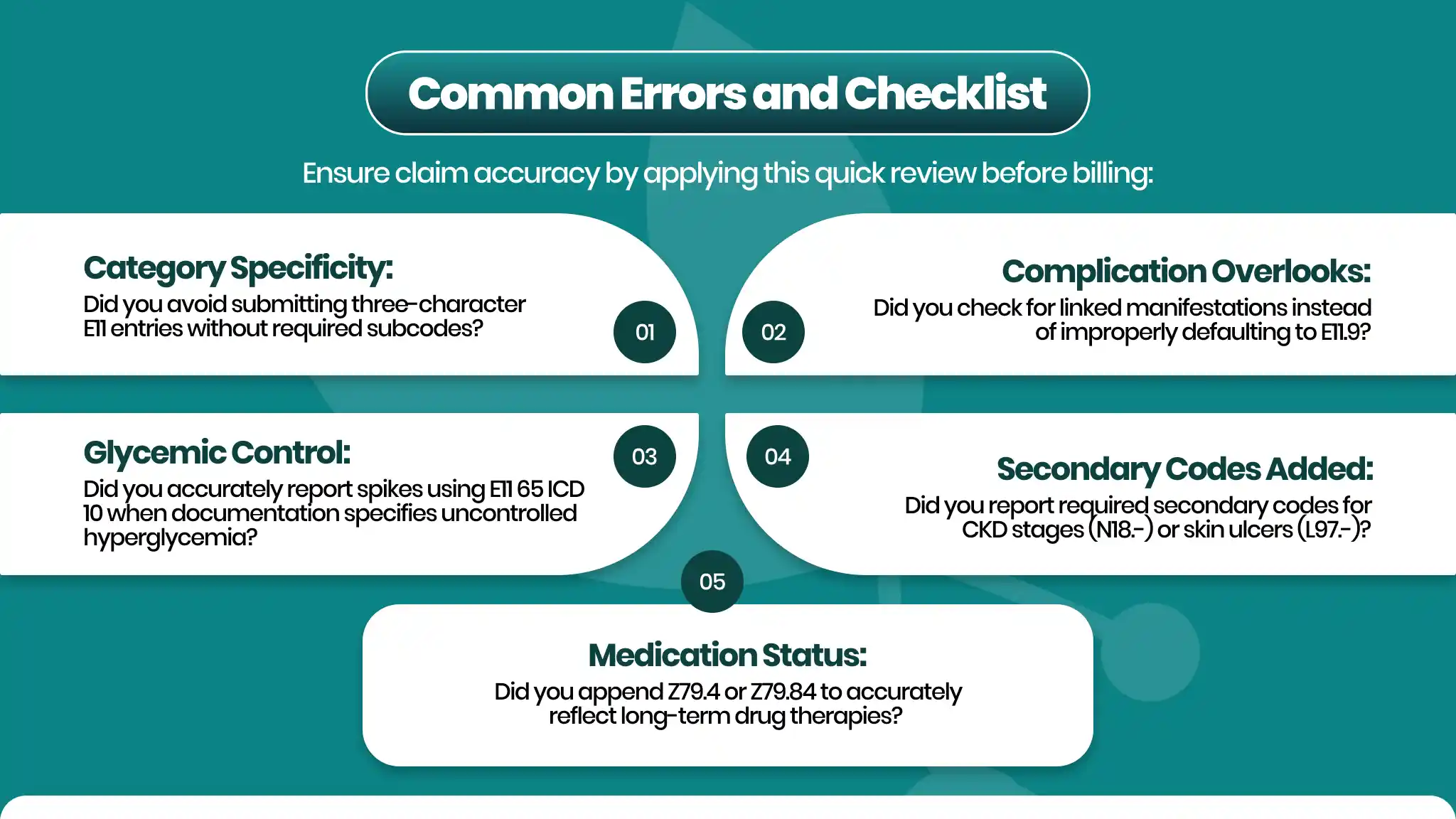
- Category Specificity: Did you avoid submitting three-character E11 entries without required subcodes?
- Complication Overlooks: Did you check for linked manifestations instead of improperly defaulting to E11.9?
- Glycemic Control: Did you accurately report spikes using E11.65 when documentation specifies uncontrolled hyperglycemia?
- Secondary Codes Added: Did you report required secondary codes for CKD stages (N18.-) or skin ulcers (L97.-)?
- Medication Status: Did you append Z79.4 or Z79.84 to accurately reflect long-term drug therapies?
Also read
Coding Support and Documentation Review
Maintaining accuracy across complex chronic disease coding requires diligent documentation reviews. Streamlining your front-end charge capture and back-end audit processes is essential for overall revenue cycle management. Need support reviewing diabetes diagnosis coding? Partnering with an expert medical coding service like GreenSense Billing helps optimize compliance and revenue cycle accuracy.
Sources
Frequently Asked Questions (FAQs)
Can E11 alone be used on a claim?
No, category E11 is an incomplete header and cannot be submitted on claims. Coders must select a complete, billable subcode like E11.9 or E11.65.
When is E11.9 appropriate?
Code E11.9 is appropriate when the provider explicitly documents Type 2 diabetes without any accompanying systemic complications, organ manifestations, or uncontrolled blood sugar events.
How does E10 differ from E11?
Comparing E10 vs E11 ICD-10 codes comes down to the underlying etiology. Category E10 represents Type 1 diabetes mellitus (autoimmune destruction of pancreatic beta cells), whereas category E11 represents Type 2 diabetes mellitus (insulin resistance or relative deficiency).
Can more than one E11 code be assigned?
Yes, official ICD-10-CM guidelines allow coders to report multiple codes from category E11 if a patient presents with multiple distinct diabetic complications, such as kidney disease (E11.22) and neuropathy (E11.42).
Does insulin use automatically mean type 1 diabetes?
No, many patients with Type 2 diabetes require insulin therapy. When a Type 2 diabetic patient uses insulin, assign the appropriate E11 subcode accompanied by code Z79.4 for long-term insulin use.


More Related Posts

-

October 16, 2026
Billing GuidesJ09.X2 ICD-10 Code: Meaning and Coding Guidance
Understand J09.X2, its influenza coding context and documentation checks. Compare related codes and review common errors before submitting a...
-

October 15, 2026
Billing GuidesICD-10 Codes: A Practical Guide for Medical Groups
Learn how ICD-10 codes support documentation, claims and practice workflows. Explore common coding errors and a practical checklist for medi...
-

October 7, 2026
Billing GuidesTop 5 Medical Credentialing Companies in Illinois (2026)
Compare 5 medical credentialing companies serving Illinois. Verified turnarounds, payer coverage, pricing and IDFPR licensing lead times.
-

-

October 2, 2026
Billing GuidesTop 5 Medical Credentialing Companies in Florida (2026)
Compare the top medical credentialing companies in Florida for 2026: services, turnaround times, pricing, and the AHCA deadlines that shape...
-

October 1, 2026
Billing GuidesTop 5 Medical Credentialing Companies in Texas for 2026
Compare five medical credentialing companies in Texas on services, turnaround, payers, and accreditation, plus the Texas rules (TSCA, PEMS,...
-

September 25, 2026
Billing GuidesBest Medical Credentialing Companies in the USA (2026)
Compare the top medical credentialing companies in the USA for 2026: turnaround times, payer networks, and pricing, so you can pick the righ...
-

September 24, 2026
Billing GuidesCost of Medical Credentialing in California in 2026
Learn the 2026 cost of medical credentialing in California, including payer enrollment, CAQH, Medicare, Medi-Cal, licensing, and ongoing fee...
-

September 23, 2026
Billing GuidesTop 7 Medical Credentialing Services for California (2026)
Navigate California's Medi-Cal, HMO, and commercial credentialing. Compare the top 7 medical credentialing services for California practices...
-

September 22, 2026
Billing GuidesTop 5 Medical Credentialing Companies in California (2026)
Compare the top 5 medical credentialing companies in California for 2026 — ranked by Medi-Cal MCO experience, turnaround time, specialty cov...
-

September 18, 2026
Billing GuidesTop 10 Medical Credentialing Companies in the USA (2026)
Compare the top 10 medical credentialing companies in the USA for 2026 by turnaround time, payer coverage, specialties, pricing, and verifie...