
ICD-10 Codes: A Practical Guide for Medical Groups

Authored by Sara Williams on October 15, 2026 · 7 minutes read


Key Takeaways
- Codes describe diagnoses ICD-10-CM reports diagnoses in every US care setting; each added character usually brings more specificity.
- Match the code set to the setting Use ICD-10-CM for diagnoses and CPT or HCPCS for outpatient services; ICD-10-PCS is for hospital inpatient procedures only.
- Documentation decides specificity Coders can only code what the provider documented — laterality, acuity and cause must be in the clinical note.
- Look up, then verify Start in the Alphabetic Index, confirm in the Tabular List, and check the code-set release matches the date of service.
- Query before billing When documentation lacks the detail to finish a code, ask the provider for clarification — never guess.
ICD-10 codes are standardized alphanumeric codes that describe diagnoses and, in hospital inpatient care, procedures. For a medical group, they connect clinical documentation to claims, reporting and review. This guide explains ICD-10-CM diagnosis codes, how they differ from other code sets, and how practice teams can keep them accurate. Strong documentation supports claim review, but a code alone never determines payment.
Quick answer: Use ICD-10-CM for diagnoses in every US care setting, CPT or HCPCS for outpatient services, and keep ICD-10-PCS for hospital inpatient procedures. Code only what the provider documented, verify every code in the Tabular List, and match the code-set release to the date of service.
What Are ICD-10 Codes?
ICD-10 is a classification system used to describe health conditions. In the United States, ICD-10-CM is the clinical modification used to report diagnoses in every care setting, from a routine office visit to a hospital stay. Codes run from three to seven characters, and each added character usually brings more specificity, such as site, type or episode of care.
This is what ICD-10 codes are used for in daily practice: explaining why a patient was seen, supporting medical necessity on a claim, and feeding quality and population reporting.
ICD-10-CM vs ICD-10-PCS
ICD-10-CM covers diagnoses. ICD-10-PCS is a separate system for hospital inpatient procedures in the US. An outpatient medical group usually reports procedures and services with CPT or HCPCS, so most practice staff work on the diagnosis side.
ICD-10 vs CPT and HCPCS
These code sets answer different questions, and they work together on a claim. There is no one-to-one crosswalk between a diagnosis and a service.
| System | Purpose | Example type | Setting |
|---|---|---|---|
| ICD-10-CM | Describes diagnoses and reasons for care | Condition code | All care settings |
| ICD-10-PCS | Describes inpatient procedures | Procedure code | Hospital inpatient |
| CPT | Describes services performed | Visit or procedure code | Outpatient and professional billing |
| HCPCS | Covers supplies, drugs and services outside CPT | Supply or drug code | Outpatient and Medicare billing |
A claim pairs services with diagnoses, and payers review whether the diagnosis supports the service billed.
How ICD-10 Affects Medical Groups
Documentation and claims
A code is only as good as the documentation behind it. Coders assign ICD-10 codes from what the provider recorded, so missing detail about laterality, acuity or cause limits specificity. On the claim, the diagnosis is tied to the service and the date of service, and payers use that pairing to judge medical necessity. Unclear entries often lead to edits, denials, or record requests, which slow medical billing and revenue cycle management and create rework.
Reporting and review
Diagnosis data also drives risk reporting, quality measures and internal audits. Consistent coding helps managers compare provider patterns and spot documentation gaps. The benefit is cleaner data and fewer surprises during review, which supports steady revenue cycle management. It is not a guaranteed revenue gain.
How to Look Up and Validate a Code
A good icd-10 codes lookup starts in the Alphabetic Index but never ends there. Find the main term, note the suggested code, then confirm it in the Tabular List. Primary resources like official CMS and CDC code tables or secondary references such as the AAPC ICD-10 Code Lookup can assist during initial research.
Once you are in the Tabular List, read the parent category, inclusion terms, excludes notes, and any instruction to code first or use an additional code. Check that the code is complete to the highest available specificity, because a category code with more characters beneath it is incomplete. Finally, confirm you are using the release that applies to the date of service, since the code set updates each fiscal year. CMS and CDC publish the current files and Official Guidelines.
Common Coding Mistakes
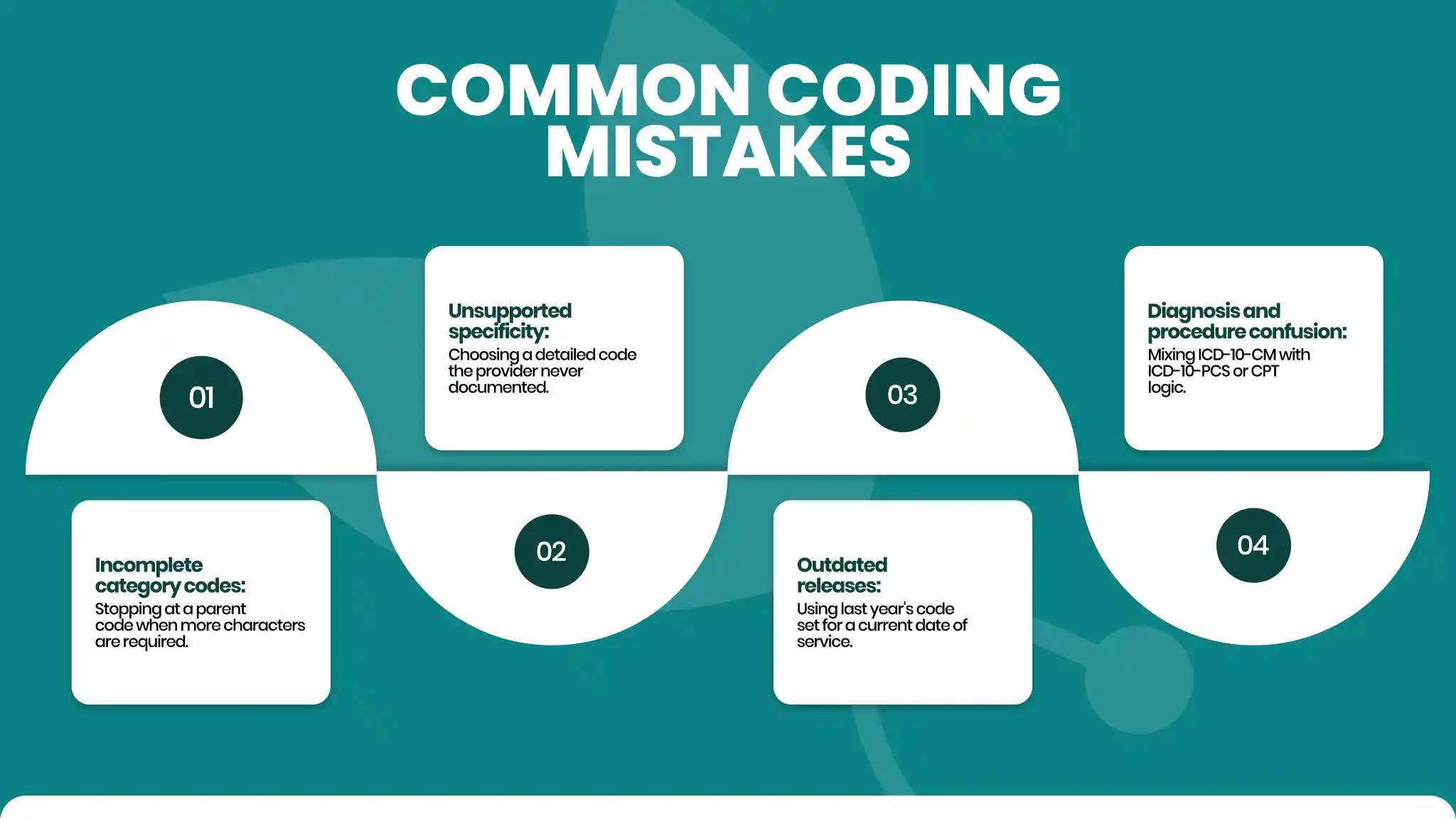
- Incomplete category codes: stopping at a parent code when more characters are required.
- Unsupported specificity: choosing a detailed code the provider never documented.
- Outdated releases: using last year's code set for a current date of service.
- Diagnosis and procedure confusion: mixing ICD-10-CM with ICD-10-PCS or CPT logic.
Here is how a gap gets caught in practice. A coder opens a note and finds a diagnostic entry that lacks the detail needed to finish the code. Instead of guessing or working backward from symptoms, the coder sends a query to the provider asking for clarification. The provider updates the documentation, and the coder completes the code afterward.
A Practical Coding Quality Checklist
- Document the diagnosis fully in the clinical note.
- Look up the term in the Alphabetic Index.
- Verify the code in the Tabular List.
- Review notes, including parent, excludes and sequencing instructions.
- Check the version that matches the date of service.
- Resolve gaps by querying the provider before billing.
Also read
Closing Guidance
Accurate coding is a habit built on clear notes, careful lookups, and quick provider queries. Need support reviewing your coding workflow? Explore our professional medical coding services.
Frequently Asked Questions (FAQs)
What are ICD-10 codes used for?
ICD-10 codes report diagnoses and, in hospital inpatient settings, procedures. They explain why care was provided, support medical necessity and feed reporting. They work alongside documentation and other code sets, and they do not decide payment on their own.
What is the difference between ICD-10-CM and ICD-10-PCS?
ICD-10-CM describes diagnoses and is used in all US care settings. ICD-10-PCS describes procedures performed during hospital inpatient stays. Outpatient practices normally use ICD-10-CM for diagnoses and CPT or HCPCS for services, so PCS rarely appears in daily workflow.
How do ICD-10 codes differ from CPT codes?
ICD-10 codes explain the diagnosis, while CPT codes describe the service performed. They appear together on a claim, but there is no one-to-one match between them. Payers review whether the documented diagnosis supports the service billed on the date of service.
Where can a practice look up ICD-10 codes?
Practices can use the official ICD-10-CM files and browser tools published by CMS and CDC, along with their coding software. For any icd-10 codes lookup, confirm the code in the Tabular List and check that the release matches the date of service.
Does a valid ICD-10 code guarantee reimbursement?
No. A valid code only means it exists in the code set. Payment depends on payer policy, medical necessity, documentation, eligibility and correct pairing with the service billed. A well-supported code helps, but it guarantees nothing.


More Related Posts

-

-

October 2, 2026
Billing GuidesTop 5 Medical Credentialing Companies in Florida (2026)
Compare the top medical credentialing companies in Florida for 2026: services, turnaround times, pricing, and the AHCA deadlines that shape...
-

October 1, 2026
Billing GuidesTop 5 Medical Credentialing Companies in Texas for 2026
Compare five medical credentialing companies in Texas on services, turnaround, payers, and accreditation, plus the Texas rules (TSCA, PEMS,...
-

September 25, 2026
Billing GuidesBest Medical Credentialing Companies in the USA (2026)
Compare the top medical credentialing companies in the USA for 2026: turnaround times, payer networks, and pricing, so you can pick the righ...
-

September 24, 2026
Billing GuidesCost of Medical Credentialing in California in 2026
Learn the 2026 cost of medical credentialing in California, including payer enrollment, CAQH, Medicare, Medi-Cal, licensing, and ongoing fee...
-
September 23, 2026
Billing GuidesTop 7 Medical Credentialing Services for California (2026)
Navigate California's Medi-Cal, HMO, and commercial credentialing. Compare the top 7 medical credentialing services for California practices...
-

September 22, 2026
Billing GuidesTop 5 Medical Credentialing Companies in California (2026)
Compare the top 5 medical credentialing companies in California for 2026 — ranked by Medi-Cal MCO experience, turnaround time, specialty cov...
-

September 18, 2026
Billing GuidesTop 10 Medical Credentialing Companies in the USA (2026)
Compare the top 10 medical credentialing companies in the USA for 2026 by turnaround time, payer coverage, specialties, pricing, and verifie...
-

September 14, 2026
Billing GuidesTop 10 Medical Billing Companies in New York (2026)
Compare the top Medical Billing Companies in New York on NY Medicaid, Empire BCBS, and behavioral health experience to find the right partne...
-

September 11, 2026
Billing GuidesTop 10 Medical Billing Companies in California (2026)
Compare the top Medical Billing Companies in California on Medi-Cal, HMO, and AB 72 experience to find the right billing partner for your pr...
-

September 10, 2026
Billing GuidesTop 10 Medical Billing Companies in Texas to Outsource (2026)
Compare the top Medical Billing Companies in Texas to Outsource on Texas MCO experience, pricing, and outsourcing model to find the right pa...