
ICD-10 Code F41.9: Anxiety Disorder, Unspecified

Authored by Sara Williams on October 30, 2026 · 10 minutes read


Key Takeaways
- F41.9 is a billable FY2027 ICD-10-CM code F41.9 is a billable FY2027 ICD-10-CM code for anxiety disorder, unspecified, and it has no FY2027 change.
- Use it only for an unnamed anxiety type Use it only when the provider documents an anxiety disorder without naming the type.
- F41.1 or F41.0 for named types If the note supports generalized anxiety disorder or panic disorder, report F41.1 or F41.0 instead.
- F41.2 does not exist in ICD-10-CM F41.2 does not exist in ICD-10-CM. Mixed anxiety and depressive disorder is reported with F41.8 on US claims.
- Documentation, not payer fear, decides Good documentation, not payer fear, should decide whether an unspecified code is used.
The F41.9 ICD-10 code often looks like the easy answer when a note says anxiety and little else. It is billable, but it is not a default. This guide explains what anxiety disorder, unspecified means, when it fits, when a more specific code is correct, and how to document before you bill.
Quick answer: F41.9 is a billable FY2027 ICD-10 code for anxiety when documented as unspecified (Anxiety NOS). Use it when the provider documents an anxiety disorder without specifying the type. If the note supports generalized anxiety disorder, panic disorder or another specified type, report that code instead.
What does ICD-10 code F41.9 mean?
F41.9 sits in the category F41, other anxiety disorders, within the block F40-F48 for anxiety, dissociative, stress-related, somatoform and other nonpsychotic mental disorders. It is a complete, billable code that you can place on a claim as is. The inclusion term under it is Anxiety NOS, which tells you the code is meant for an anxiety diagnosis that the provider has not narrowed down.
| Item | Detail |
|---|---|
| Code | F41.9 |
| Title | Anxiety disorder, unspecified |
| Inclusion term | Anxiety NOS |
| Category | F41 (header, not billable on its own) |
| Block | F40-F48 |
| Billable for FY2027 | Yes |
| FY2027 change | None |
One point trips up new coders. The word "unspecified" describes the documentation, not the severity of the patient's condition. A patient with significant symptoms can still carry an unspecified diagnosis if the provider has not yet settled on a type.
The official coding guidelines come directly from the CDC National Center for Health Statistics and official ICD-10-CM tabular lists.
When F41.9 is the right code
The ICD-10-CM Official Guidelines for Coding and Reporting allow an unspecified code when the documentation does not support more detail. That is the whole test. If the provider writes an anxiety disorder and the record contains nothing that points to a specific type, F41.9 is accurate and defensible.
The typical case is an early evaluation. A new patient arrives, the clinician confirms an anxiety disorder, but the full picture, such as duration, triggers and symptom pattern, is still being gathered. Behavioral health teams see this often at intake. If you want the context for that visit, read our guide on how to bill CPT code 90791, the psychiatric diagnostic evaluation.
The code is also reasonable in primary care, where a physician documents anxiety as a diagnosis but refers the patient out before a workup is complete. The key is that the provider actually made an anxiety disorder diagnosis. A single symptom, such as "feels anxious," is a different matter and should not be coded as a disorder.
When a more specific code fits
Do not stop at F41.9 if the note says more. Coders should always scan the full record for the type of anxiety before settling on the unspecified code. The table below shows where a more precise code takes over.
| If the documentation says | Use instead |
|---|---|
| Generalized anxiety disorder | F41.1 |
| Panic disorder | F41.0 |
| Mixed anxiety and depressive disorder | F41.8 |
| Other specified anxiety disorder | F41.8 |
| Other mixed anxiety disorders | F41.3 |
| Anxiety due to a known physiological condition | F06.4 |
| Adjustment disorder with anxiety | F43.22 |
| Social phobia | F40.10 or F40.11 |
| Separation anxiety disorder of childhood | F93.0 |
The pattern is simple. Whenever the provider names the condition, the named code wins. F41.9 is for the cases where no such name appears.
F41.9 vs F41.1
Understanding F41.9 vs F41.1 comes down to documentation rather than personal preference. A coder cannot pick F41.1 because it feels more accurate, and a provider should not leave the diagnosis vague just to keep a claim simple.
| Data field | F41.9 | F41.1 |
|---|---|---|
| Meaning | Anxiety disorder, unspecified | Generalized anxiety disorder |
| Documentation needed | An anxiety disorder diagnosis, type not stated | Provider states generalized anxiety disorder |
| Typical timing | Early evaluation or incomplete workup | Established or confirmed diagnosis |
| Billable | Yes | Yes |
For a full walk-through of the specific code, see our companion guide on the F41.1 ICD-10 code.
F41.2 does not exist in ICD-10-CM
Many coders search for F41.2 and find nothing, and there is a reason. The World Health Organization version of ICD-10 uses F41.2 for mixed anxiety and depressive disorder. The US clinical modification does not carry that code. On US claims, mixed anxiety and depressive disorder is reported with F41.8. If a payer rejects F41.2 or a system will not accept it, this is why.
What the Excludes2 note at F41 allows
The F41 category carries an Excludes2 note. This matters because an Excludes2 note means the listed condition is not part of the code, so both conditions may be reported together when both are documented. It is different from an Excludes1 note, which blocks reporting the two together.
| Condition under the F41 Excludes2 note | Code range |
|---|---|
| Anxiety in acute stress reaction | F43.0 |
| Transient adjustment reaction | F43.2 |
| Neurasthenia | F48.8 |
| Psychophysiologic disorders | F45.- |
| Separation anxiety | F93.0 |
In practice, a patient with an adjustment disorder and a documented anxiety disorder can carry both codes when the record supports each one.
Documentation that supports F41.9
Strong documentation is what keeps an unspecified code from becoming a problem later. A clean note usually includes three things:
- A diagnosis statement that names an anxiety disorder, not just a symptom.
- A clear reason the type is not yet specified, such as an initial visit or pending assessment.
- A plan to reassess and refine the diagnosis at a later visit.
If the note is vague, query the provider before the claim goes out. Ask whether the clinician can specify the type, or confirm that the type truly is undetermined. A short query now is cheaper than a rework later.
A word on payers. Some payers apply extra review to unspecified mental health codes, but that is not a universal rule, and F41.9 is not denied by default. Each practice should check its own payer policies and track its own results. If a claim does come back, our guide on managing denied claims explains how to respond and prevent repeats.
Two illustrative coding scenarios
These are hypothetical examples to show the logic.
- Scenario A. A new patient attends an initial evaluation. The provider documents "anxiety disorder, type to be determined" and schedules a follow-up. The correct code for this visit is F41.9, because an anxiety disorder is documented but the type is not.
- Scenario B. At the follow-up, the provider documents generalized anxiety disorder after further assessment. The diagnosis is now specific, so the code updates to F41.1 for this and later visits. The earlier F41.9 claim stays as it was, since it matched the documentation on that date.
Common errors and pre-claim checklist
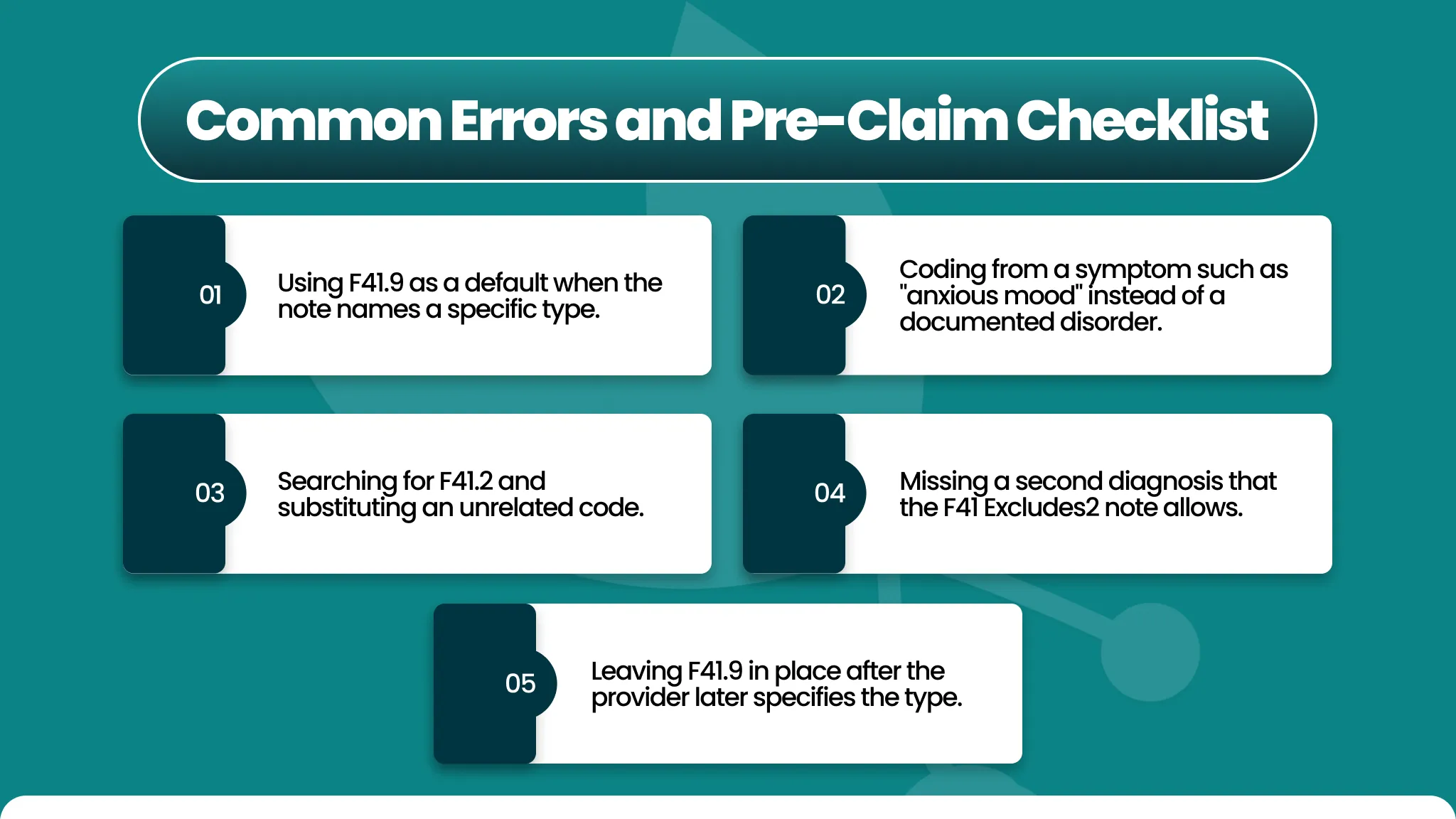
Most F41.9 problems come from habit, not from the code itself. These are the errors that show up most often:
- Using F41.9 as a default when the note names a specific type.
- Coding from a symptom such as "anxious mood" instead of a documented disorder.
- Searching for F41.2 and substituting an unrelated code.
- Missing a second diagnosis that the F41 Excludes2 note allows.
- Leaving F41.9 in place after the provider later specifies the type.
Before you submit, run through this quick checklist:
- Does the note document an anxiety disorder, not only a symptom?
- Does anything in the record name a more specific type?
- Is the reason for the unspecified type clear?
- Are any Excludes2 conditions documented and coded when they apply?
- Does the code match the date of service and the current note?
If your team sees recurring gaps in behavioral health notes, a short documentation review with your providers often fixes most of them at the source.
Also read
- ICD-10 Codes for Mental Health Disorders: 2027 Coding Guide
- ICD-10 Code F33.1: Major Depressive Disorder, Recurrent, Moderate
- ICD-10 Codes: A Practical Guide for Medical Groups
- E11 ICD-10 Codes: Type 2 Diabetes Coding Guide
- E66 ICD-10 Codes: Obesity Coding and BMI Documentation
- G43.909 ICD-10 Code: Migraine Coding Guide
- Behavioral Health Billing Guide
Coding support for behavioral health practices
Accurate diagnosis coding protects your revenue and your compliance posture. GreenSense Billing supports behavioral health and primary care practices with medical coding services, medical billing services, and end-to-end revenue cycle management — including coding review, claim scrubbing and denial follow-up, so unspecified codes are used only when the record calls for them.
Need a second set of eyes on your mental health claims? Talk to the GreenSense Billing team about coding support built for your practice.
Sources
Frequently Asked Questions (FAQs)
Is F41.9 a billable ICD-10 code?
Yes, it is a fully billable FY2027 ICD-10-CM code for anxiety disorder, unspecified, with no changes for the FY2027 code set.
What is the difference between F41.9 and F41.1?
F41.9 is used when an anxiety disorder is documented without a type. F41.1 is used when the provider documents generalized anxiety disorder. The difference comes from documentation.
Does ICD-10-CM have a code F41.2?
No. The WHO version of ICD-10 uses F41.2 for mixed anxiety and depressive disorder, but US claims use F41.8 for that condition.
Can F41.9 be reported with other codes?
Yes, when the record supports it. The Excludes2 note at F41 means conditions such as adjustment disorder or separation anxiety may be coded alongside it when both are documented.


More Related Posts
-
October 26, 2026
Billing GuidesICD-10 Codes for Mental Health Disorders: 2027 Coding Guide
Mental health diagnoses use ICD-10-CM Chapter 5 codes (F01-F99). This FY2027 guide covers the block map, billable vs header codes, and a pre...
-
October 21, 2026
Billing GuidesG43.909 ICD-10 Code: Migraine Coding Guide
Learn what G43.909 means, which migraine details matter and how related codes differ. Use a practical documentation checklist before claim s...
-

October 20, 2026
Billing GuidesE11 ICD-10 Codes: Type 2 Diabetes Coding Guide
Understand the E11 code family for type 2 diabetes. Compare common subcodes, documentation needs and additional-code checks before submittin...
-
October 19, 2026
Billing GuidesE66 ICD-10 Codes: Obesity Coding and BMI Documentation
E66 ICD-10 codes: obesity subcodes, BMI documentation, and pre-claim checks for cleaner claims.
-
October 16, 2026
Billing GuidesJ09.X2 ICD-10 Code: Meaning and Coding Guidance
Understand J09.X2, its influenza coding context and documentation checks. Compare related codes and review common errors before submitting a...
-
October 15, 2026
Billing GuidesICD-10 Codes: A Practical Guide for Medical Groups
Learn how ICD-10 codes support documentation, claims and practice workflows. Explore common coding errors and a practical checklist for medi...
-

October 7, 2026
Billing GuidesTop 5 Medical Credentialing Companies in Illinois (2026)
Compare 5 medical credentialing companies serving Illinois. Verified turnarounds, payer coverage, pricing and IDFPR licensing lead times.
-

-

October 2, 2026
Billing GuidesTop 5 Medical Credentialing Companies in Florida (2026)
Compare the top medical credentialing companies in Florida for 2026: services, turnaround times, pricing, and the AHCA deadlines that shape...
-

October 1, 2026
Billing GuidesTop 5 Medical Credentialing Companies in Texas for 2026
Compare five medical credentialing companies in Texas on services, turnaround, payers, and accreditation, plus the Texas rules (TSCA, PEMS,...
-

September 25, 2026
Billing GuidesBest Medical Credentialing Companies in the USA (2026)
Compare the top medical credentialing companies in the USA for 2026: turnaround times, payer networks, and pricing, so you can pick the righ...