
ICD-10 Codes for Depression: F32 vs F33 Explained

Authored by Sara Williams on November 3, 2026 · 12 minutes read


Key Takeaways
- F32 vs F33: single vs recurrent F32 codes a single depressive episode; F33 codes recurrent major depressive disorder — and the two families never appear together on one claim, because F32 carries an Excludes1 note for F33.
- Neither category is billable alone Neither F32 nor F33 is billable alone — both are headers, so use the complete code for the documented severity or remission status.
- “Depression” alone maps to F32.A A note that only says “depression” maps to F32.A since October 2021 — not F32.9, which means major depressive disorder, single episode, unspecified.
- Remission codes differ by family Remission codes differ by family and must be provider-documented: F32.4/F32.5 for a single episode, F33.40/F33.41/F33.42 for recurrent.
- No FY2027 change Neither category changed in FY2027 (October 1, 2026 through September 30, 2027); the last real change was F32.A in October 2021.
Depression is one of the most frequently billed diagnoses in both behavioral health and primary care, and the ICD-10 codes for depression are also some of the easiest to get wrong. The core confusion is simple. Two code families sit side by side, F32 and F33, and a single wrong choice can trigger a denial or a coding audit. This guide explains how the two families differ, how severity and remission fit in, and how to handle vague notes that just say “depression.” It belongs to our wider ICD-10 codes for mental health disorders guide.
Quick answer: F32 (Depressive episode) codes a single episode of depression, including depression NOS (F32.A). F33 codes major depressive disorder, recurrent. Neither category is billable alone: choose the complete code that matches the provider’s documented episode type, current severity and remission status. Neither category changed in the FY2027 update.
F32 vs F33 at a glance
Understanding F32 vs F33 is essential for behavioral health coders, as picking the wrong family is one of the most common causes of claim rejections. When reviewing guidelines for F32 vs F33 2027, note that neither category underwent code revisions for the current fiscal year.
| Item | F32 | F33 |
|---|---|---|
| Category title | Depressive episode | Major depressive disorder, recurrent |
| Episode type | Single episode | Recurrent episodes |
| Billable codes | F32.0 to F32.5, F32.81, F32.89, F32.9, F32.A | F33.0 to F33.3, F33.40 to F33.42, F33.8, F33.9 |
| Severity codes | F32.0, F32.1, F32.2, F32.3 | F33.0, F33.1, F33.2, F33.3 |
| Remission codes | F32.4, F32.5 | F33.40, F33.41, F33.42 |
| Unspecified codes | F32.9, F32.A | F33.9 |
| Excludes1 | Recurrent depressive disorder (F33.-), bipolar disorder (F31.-), manic episode (F30.-) | Bipolar disorder (F31.-), manic episode (F30.-) |
| FY2027 change | None | None |
The row that causes the most trouble is the Excludes1 row. Because F32 excludes F33, the two families never appear together on one claim.
F32 codes: single depressive episode
The F32 family covers a single episode of depression. The category was retitled “Depressive episode” effective October 1, 2021, when F32.A was introduced. That change is documented in AHA Coding Clinic, 2021 Quarter 4.
| Code | Official title |
|---|---|
| F32 | Depressive episode (header, not billable) |
| F32.0 | Major depressive disorder, single episode, mild |
| F32.1 | Major depressive disorder, single episode, moderate |
| F32.2 | Major depressive disorder, single episode, severe without psychotic features |
| F32.3 | Major depressive disorder, single episode, severe with psychotic features |
| F32.4 | Major depressive disorder, single episode, in partial remission |
| F32.5 | Major depressive disorder, single episode, in full remission |
| F32.8 | Other depressive episodes (header, not billable) |
| F32.81 | Premenstrual dysphoric disorder |
| F32.89 | Other specified depressive episodes |
| F32.9 | Major depressive disorder, single episode, unspecified |
| F32.A | Depression, unspecified |
Notice that F32 and F32.8 are headers. They organize the list but cannot go on a claim by themselves.
F33 codes: major depressive disorder, recurrent
The F33 family follows a similar structure for patients with more than one episode.
| Code | Official title |
|---|---|
| F33 | Major depressive disorder, recurrent (header, not billable) |
| F33.0 | Major depressive disorder, recurrent, mild |
| F33.1 | Major depressive disorder, recurrent, moderate |
| F33.2 | Major depressive disorder, recurrent severe without psychotic features |
| F33.3 | Major depressive disorder, recurrent, severe with psychotic symptoms |
| F33.4 | Major depressive disorder, recurrent, in remission (header, not billable) |
| F33.40 | Major depressive disorder, recurrent, in remission, unspecified |
| F33.41 | Major depressive disorder, recurrent, in partial remission |
| F33.42 | Major depressive disorder, recurrent, in full remission |
| F33.8 | Other recurrent depressive disorders |
| F33.9 | Major depressive disorder, recurrent, unspecified |
The most commonly reported code in this family is F33.1, and we cover it in detail in our F33.1 ICD-10 code guide.
The first decision: single episode or recurrent
Every depression code starts with one question: is this a single episode or a recurrent disorder? The answer comes from the provider, not the coder. Coders should not count past episodes in the chart and decide for themselves. The clinical rules for separating one episode from the next come from the DSM-5-TR, published by the American Psychiatric Association (APA). In general, the APA requires a period of at least two consecutive months without meeting full criteria before a new episode counts as separate, but the diagnosing clinician applies that standard.
Distinguishing between a single episode vs recurrent depression ICD-10 diagnosis relies strictly on clinical documentation, not coder assumption. If you are unsure which depression ICD-10 code to use, query the provider to clarify whether past depressive episodes occurred before assigning a code.
If the note does not state whether the episode is single or recurrent, a query is the right move. Guessing leads straight to a mismatch. Remember that F32 has an Excludes1 note for F33, so once you pick one family, the other is off the table for that encounter. You can confirm the notes in the ICD-10-CM Tabular List.
Severity and remission: coding the current episode
Once the episode type is clear, the next step is the current state of the illness. Severity describes how the present episode looks right now: mild, moderate, or severe, with or without psychotic features. A provider who documents “moderate” points you to F32.1 or F33.1, depending on episode type.
Remission works differently, and the codes are not interchangeable between families:
- Single episode: F32.4 for partial remission, F32.5 for full remission.
- Recurrent: F33.40 for remission unspecified, F33.41 for partial remission, F33.42 for full remission.
Coding depression in remission ICD-10 codes requires explicit provider documentation stating whether the remission is partial or full.
A provider documenting “major depressive disorder, recurrent, in partial remission” points to F33.41. The same patient on a different note might have no remission documented at all, in which case severity applies instead.
Remission status has to be stated by the provider. A coder should never assume it because the patient “seems better.”
F32.A vs F32.9 vs F33.9
This is the section that saves the most claims, because the three unspecified codes look alike and mean different things. A key distinction in mental health billing is F32.A vs F32.9, as using them interchangeably can trigger claim audits.
Assign F32.A depression unspecified only when the encounter note states “depression” without detailing a major depressive disorder ICD-10 classification.
| Code | Title | When it applies |
|---|---|---|
| F32.A | Depression, unspecified | The note says “depression” or “depression NOS” with no major depressive disorder diagnosis |
| F32.9 | Major depressive disorder, single episode, unspecified | The provider diagnoses major depressive disorder, a single episode, but gives no severity |
| F33.9 | Major depressive disorder, recurrent, unspecified | The provider diagnoses recurrent major depressive disorder but gives no severity |
Here is the practical point. Before October 2021, “depression” mapped to F32.9. Since then, F32.9 has meant major depressive disorder, single episode, unspecified, which is a more specific diagnosis than “depression.” Many EHR favorites lists and superbills were built before that change and still map “depression” to F32.9. We recommend auditing those lists. Our post on outdated ICD-10 codes explains how to find them.
When comparing F33.9 vs F32.9, remember that F33.9 indicates recurrent episodes, whereas F32.9 specifies a single episode.
Selecting the correct unspecified depression ICD-10 code often comes down to auditing outdated EHR templates created prior to the October 2021 update.
Codes that look like depression but belong elsewhere
A number of diagnoses feel like depression but have their own codes. Using F32 or F33 for them is a common error.
- F34.1, dysthymic disorder: persistent depressive disorder is a separate diagnosis.
- F43.21, adjustment disorder with depressed mood: F32 carries an Excludes2 note for adjustment disorder, so the two are not the same condition.
- F06.31 and F06.32: mood disorder due to a known physiological condition, with depressive features or with a major depressive-like episode.
- F32.81, premenstrual dysphoric disorder: it sits inside the F32 family but describes a different condition.
- F31.-, bipolar disorder: Excludes1 applies, so bipolar depression is never coded to F32 or F33.
The deciding factor is always the provider’s documented diagnosis, not the word “depressed” on its own.
Did F32 or F33 change for FY2027?
No. Neither category changed in the FY2027 update, which applies to dates of service from October 1, 2026 through September 30, 2027. The most recent real change to this area was the October 2021 update that introduced F32.A. You can confirm the current code set on the CMS ICD-10-CM page.
Two illustrative coding scenarios
These are hypothetical examples.
- Scenario A. A primary care note reads “patient reports depression, discussed options.” There is no diagnosis of major depressive disorder. The correct code is F32.A.
- Scenario B. A psychiatrist documents “major depressive disorder, recurrent, in partial remission.” The correct code is F33.41.
In both cases, the code is whatever the note supports, no more and no less.
Common errors and pre-claim checklist
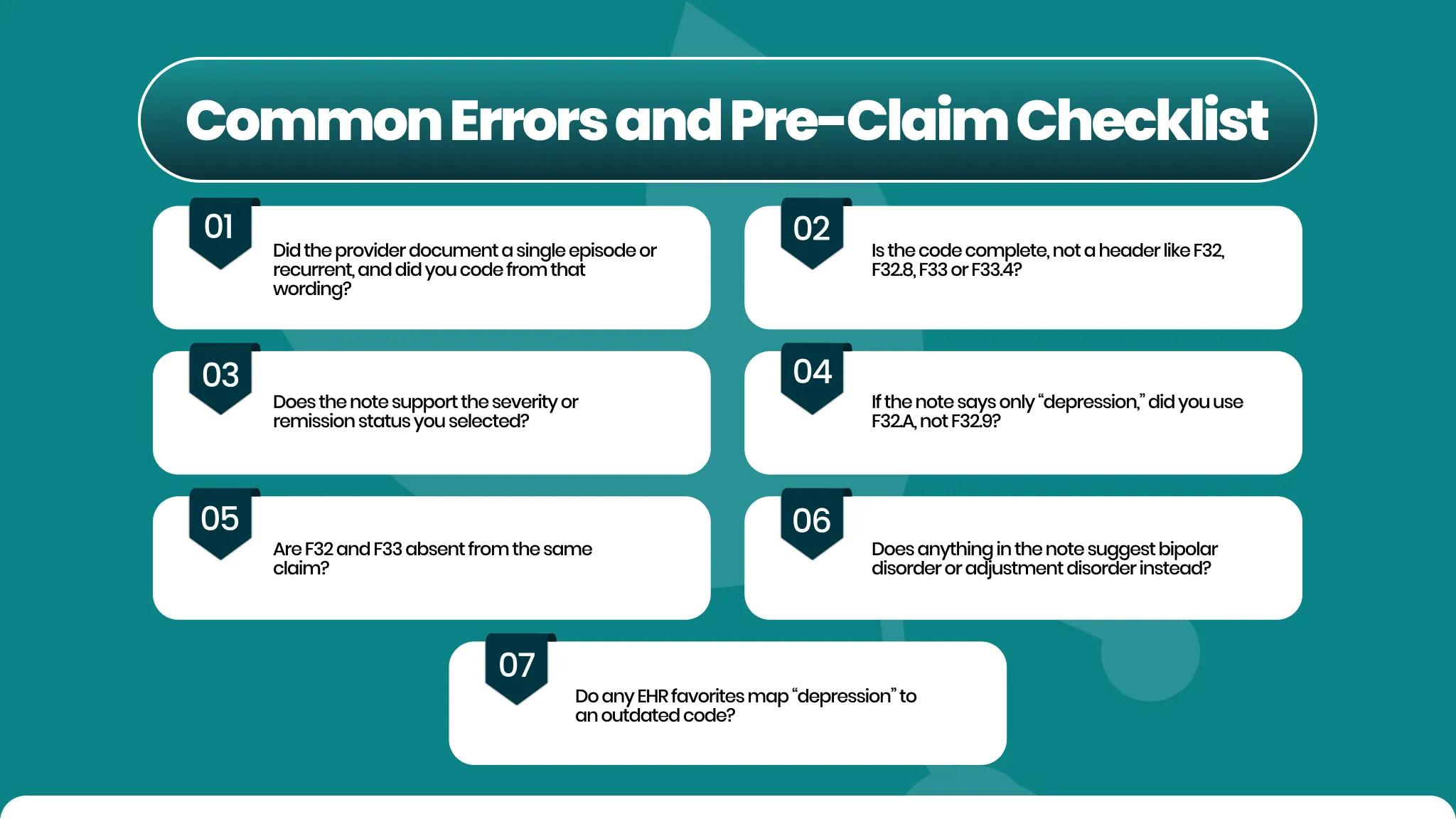
Most depression coding problems repeat. Use this pre-claim checklist before submitting:
- Did the provider document a single episode or recurrent, and did you code from that wording?
- Is the code complete, not a header like F32, F32.8, F33 or F33.4?
- Does the note support the severity or remission status you selected?
- If the note says only “depression,” did you use F32.A, not F32.9?
- Are F32 and F33 absent from the same claim?
- Does anything in the note suggest bipolar disorder or adjustment disorder instead?
- Do any EHR favorites map “depression” to an outdated code?
Be careful with severity in particular. Guessing “moderate” when the note is silent risks upcoding, and defaulting to an unspecified code when the note supports more detail risks downcoding. Both create problems in an audit. Our post on upcoding and downcoding explains the risks in more depth. A quick review of this checklist before each batch of claims is a small effort that prevents the most common rework.
Also read
- ICD-10 Codes for Mental Health Disorders: 2027 Coding Guide
- ICD-10 Code F33.1: Major Depressive Disorder, Recurrent, Moderate
- ICD-10 Code F41.1: Generalized Anxiety Disorder
- ICD-10 Code F41.9: Anxiety Disorder, Unspecified
- ICD-10 Codes: A Practical Guide for Medical Groups
- E11 ICD-10 Codes: Type 2 Diabetes Coding Guide
- E66 ICD-10 Codes: Obesity Coding and BMI Documentation
- G43.909 ICD-10 Code: Migraine Coding Guide
- Behavioral Health Billing Guide
Coding support from GreenSense Billing
Depression coding rewards care, and the gap between a clean claim and a denial is often a single word in the note. GreenSense Billing supports behavioral health and primary care teams with medical coding services, medical billing services, and end-to-end revenue cycle management — accurate coding and clean claim submission. If your team wants a second set of eyes on its mental health billing, we are glad to help.
Frequently Asked Questions (FAQs)
What is the difference between F32 and F33?
F32 codes a single depressive episode; F33 codes major depressive disorder, recurrent.
Can F32 and F33 appear on the same claim?
No. F32 carries an Excludes1 note for F33, so the two families never appear together on one claim.
What code do I use when the note just says “depression”?
F32.A, depression unspecified — not F32.9, which means major depressive disorder, single episode, unspecified.
Is F32 billable by itself?
No. F32 is a header category, not a billable code — use the complete code that matches the documented severity or remission status.
Did F32 or F33 change for FY2027?
No. Neither category changed in the FY2027 update, which applies to dates of service from October 1, 2026 through September 30, 2027.


More Related Posts
-
October 30, 2026
Billing GuidesICD-10 Code F41.9: Anxiety Disorder, Unspecified
F41.9 is a billable FY2027 ICD-10-CM code for anxiety disorder, unspecified — but it is not a default. Use it only when the provider documen...
-
October 29, 2026
Billing GuidesICD-10 Code F33.1: Major Depressive Disorder, Recurrent, Moderate
F33.1 is a billable FY2027 ICD-10-CM code for major depressive disorder, recurrent, moderate. Use it when the provider documents a recurrent...
-
October 26, 2026
Billing GuidesICD-10 Codes for Mental Health Disorders: 2027 Coding Guide
Mental health diagnoses use ICD-10-CM Chapter 5 codes (F01-F99). This FY2027 guide covers the block map, billable vs header codes, and a pre...
-
October 21, 2026
Billing GuidesG43.909 ICD-10 Code: Migraine Coding Guide
Learn what G43.909 means, which migraine details matter and how related codes differ. Use a practical documentation checklist before claim s...
-

October 20, 2026
Billing GuidesE11 ICD-10 Codes: Type 2 Diabetes Coding Guide
Understand the E11 code family for type 2 diabetes. Compare common subcodes, documentation needs and additional-code checks before submittin...
-
October 19, 2026
Billing GuidesE66 ICD-10 Codes: Obesity Coding and BMI Documentation
E66 ICD-10 codes: obesity subcodes, BMI documentation, and pre-claim checks for cleaner claims.
-

October 16, 2026
Billing GuidesJ09.X2 ICD-10 Code: Meaning and Coding Guidance
Understand J09.X2, its influenza coding context and documentation checks. Compare related codes and review common errors before submitting a...
-
October 15, 2026
Billing GuidesICD-10 Codes: A Practical Guide for Medical Groups
Learn how ICD-10 codes support documentation, claims and practice workflows. Explore common coding errors and a practical checklist for medi...
-

October 7, 2026
Billing GuidesTop 5 Medical Credentialing Companies in Illinois (2026)
Compare 5 medical credentialing companies serving Illinois. Verified turnarounds, payer coverage, pricing and IDFPR licensing lead times.
-

-

October 2, 2026
Billing GuidesTop 5 Medical Credentialing Companies in Florida (2026)
Compare the top medical credentialing companies in Florida for 2026: services, turnaround times, pricing, and the AHCA deadlines that shape...