
J09.X2 ICD-10 Code: Meaning and Coding Guidance

Authored by Sara Williams on October 16, 2026 · 8 minutes read



Key Takeaways
- J09.X2 is novel flu only J09.X2 covers confirmed novel influenza A with respiratory manifestations — never seasonal flu.
- Pneumonia changes the code Novel flu with pneumonia is J09.X1; J09.X2 requires documented absence of pneumonia.
- Strain must be confirmed A routine rapid flu test points to J10; J09.X2 needs lab-confirmed novel strain or an explicit provider statement.
- Do not double-code manifestations Pharyngitis, laryngitis and acute URI symptoms are integral to J09.X2 — Excludes1 blocks J00–J06 alongside it.
- Check the release year Use the active fiscal year code set and Tabular List notes before submitting the claim.
When patients present with acute respiratory symptoms caused by flu, medical coders must pinpoint the exact strain and clinical manifestations documented in the chart. J09.X2 ICD-10 code applies strictly to confirmed novel influenza A virus strains that manifest with upper or lower respiratory symptoms outside of pneumonia.
The official J09.X2 ICD-10 description according to the official CMS and CDC ICD-10-CM release reads: "Influenza due to identified novel influenza A virus with other respiratory manifestations."
Quick answer: J09.X2 is ICD-10-CM for influenza due to an identified novel influenza A virus with respiratory manifestations other than pneumonia. Use it only with a lab-confirmed novel strain (or an explicit provider statement) and documented absence of pneumonia — otherwise J10.1, J11.1, or J09.X1 applies.
What Does J09.X2 Mean?
Category J09 is reserved exclusively for non-seasonal, novel influenza A viruses. This includes specific non-human or emerging strains transmitted to humans, such as avian flu or swine flu strains that have not established seasonal circulation.
Coders should note that ICD-10-CM J09.X2 covers non-pneumonic respiratory manifestations including acute laryngitis, pharyngitis, or general upper respiratory symptoms directly driven by the novel virus.
| Field | Detail |
|---|---|
| ICD-10-CM Code | J09.X2 |
| Official Label | Influenza due to identified novel influenza A virus with other respiratory manifestations |
| Category & Section | J09 (Influenza due to certain identified influenza viruses) / Diseases of the Respiratory System (J00–J99) |
| Code Status | Billable / Specific HIPAA code |
| Applicable Release | Current Fiscal Year ICD-10-CM Guidelines |
| Claim-Use Caveat | Requires documented laboratory confirmation or explicit provider diagnostic statement identifying a novel influenza A strain. |
J09.X2 vs Related Influenza Codes
Selecting the wrong code category during flu season leads to claim denials and distorted epidemiological reporting. Comparing J09.X2 with J10.1 highlights why ICD-10-CM J09.X2 must be differentiated from pneumonic novel flu cases as well as standard seasonal influenza strains.
| Code | Virus Context | Manifestation | Documentation Check |
|---|---|---|---|
| J09.X1 | Novel influenza A (e.g., avian or novel swine flu) | Pneumonia | Confirm diagnostic imaging or provider statement of novel flu pneumonia. |
| J09.X2 | Novel influenza A | Other respiratory manifestations (laryngitis, pharyngitis, acute URI) | Confirm identified novel strain + respiratory symptoms without pneumonia. |
| J10.1 | Seasonal influenza A or B (identified standard viral strain) | Other respiratory manifestations | Confirm positive seasonal flu test (e.g., routine rapid flu A/B). |
| J11.1 | Unidentified influenza virus | Other respiratory manifestations | Use when flu is clinically diagnosed but no specific viral strain is isolated. |
Documentation Needed Before Coding
Assigning ICD-10 J09.X2 requires clear, unambiguous provider documentation. A generic positive result on a routine point-of-care rapid influenza test indicates seasonal flu (category J10) and does not justify novel influenza coding.
To support J09.X2, medical record audits look for:
- Specific Strain Identification: Confirmed lab isolation via specialized PCR/CDC testing (e.g., Avian H5N1 or a novel swine-origin strain) or explicit provider documentation stating "novel influenza A".
- Respiratory Clinical Picture: Direct documentation of non-pneumonic respiratory signs, such as influenzal pharyngitis, acute laryngitis, or severe URI symptoms.
- Absence of Pneumonia: Negative chest radiograph or clinical examination ruling out lower respiratory consolidation.
Detailed documentation guidelines can also be verified directly through primary sources like the AAPC J09.X2 Code Reference.
Coding Notes and Additional Diagnoses
Reviewing the official ICD-10-CM Tabular List reveals crucial instructional notes for category J09:
- Excludes1 Notes: Category J09 excludes seasonal influenza A (J10.-), seasonal H1N1 influenza (J10.-), and influenza due to unidentified virus (J11.-). These cannot be coded alongside J09.X2.
- Excludes Notes on Respiratory Infections: Category J00-J06 (Acute upper respiratory infections) carries an Excludes note for influenza viruses with respiratory manifestations (J09.X2, J10.1, J11.1). Manifestations like acute pharyngitis are integral to the flu diagnosis and are not coded separately.
- Use Additional Code Notes: Instructions direct coders to use an additional code, if applicable, for associated manifestations like sinusitis (J01.-) or pleural effusion (J91.8).
Two Illustrative Coding Scenarios
Scenario A: Fully Supported Novel Strain (Hypothetical)
A patient presents to an acute care clinic with severe fever, cough, and throat pain after direct contact with poultry. Specialized state public health lab testing confirms novel avian influenza A (H5N1). Chest X-rays are clear for pneumonia.
- Primary Coding: J09.X2 (Influenza due to identified novel influenza A virus with other respiratory manifestations).
- Rationale: Supported by specific laboratory confirmation of a novel strain and respiratory involvement without pneumonia.
Scenario B: Unclear Record Requiring Clarification (Hypothetical)
A chart lists "Flu A positive" from a standard in-office rapid swab, with the physician writing "Novel flu infection suspect." No confirmatory subtype testing was ordered or documented.
- Coding Action: Query the provider before submitting J09.X2.
- Rationale: A routine rapid test cannot verify a novel strain. If unconfirmed, standard seasonal influenza A coding (J10.1) or unidentified flu (J11.1) must be reported.
Common Errors and Pre-Claim Checklist
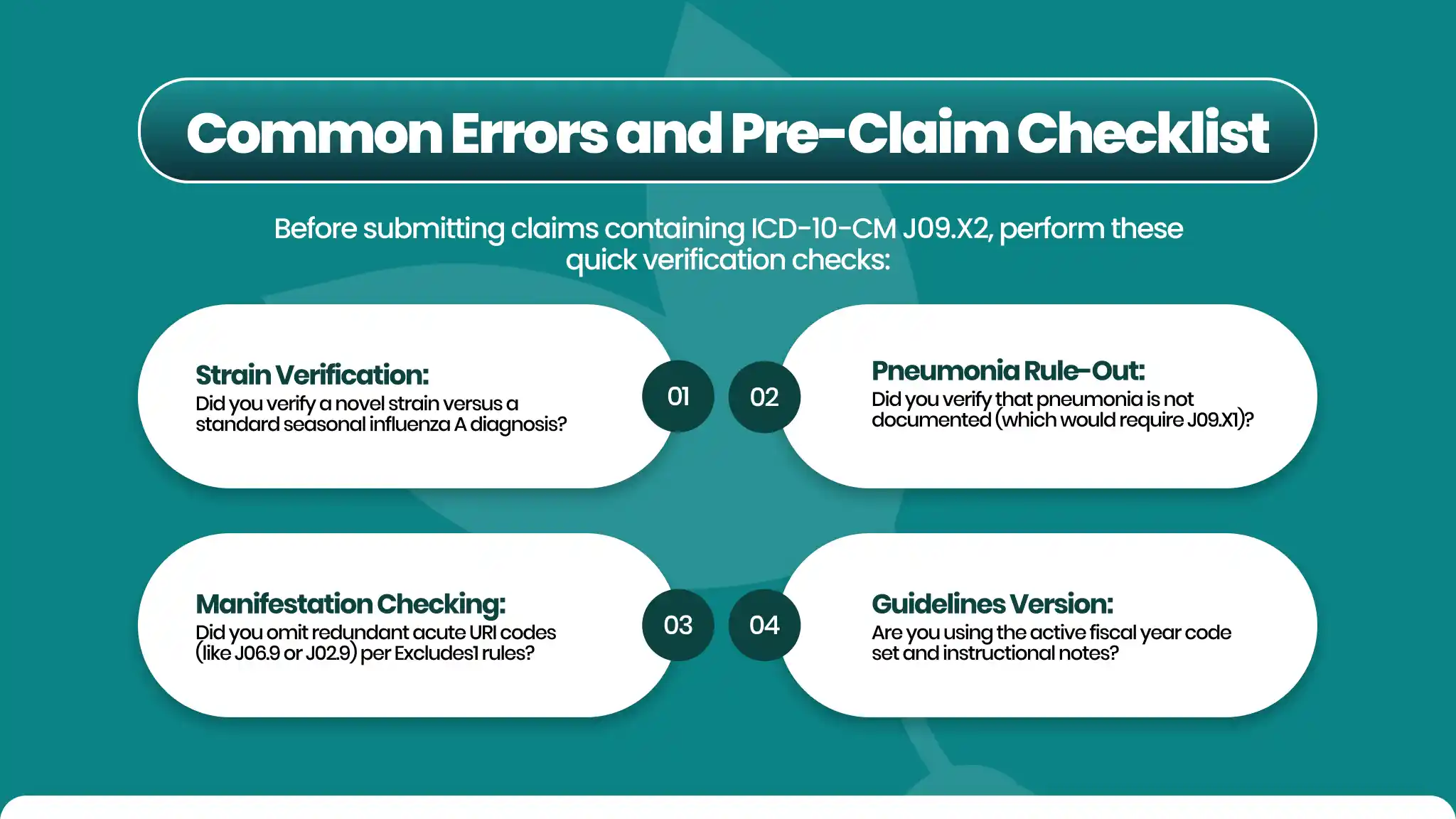
Before submitting claims containing ICD-10-CM J09.X2, perform these quick verification checks:
- Strain Verification: Did you verify a novel strain versus a standard seasonal influenza A diagnosis?
- Pneumonia Rule-Out: Did you verify that pneumonia is not documented (which would require J09.X1)?
- Manifestation Checking: Did you omit redundant acute URI codes (like J06.9 or J02.9) per Excludes1 rules?
- Guidelines Version: Are you using the active fiscal year code set and instructional notes?
Also read
Coding Support and Documentation Review
Effective denial management relies heavily on precise documentation and reliable medical coding services to keep claim rejections to a minimum. Optimizing these critical touchpoints strengthens your practice's overall RCM strategy and ensures faster reimbursement.
Proper coding compliance prevents costly claim audits and billing delays. If your practice needs expert help reviewing complex respiratory diagnosis documentation, explore our specialized coding support services at GreenSense Billing.
Frequently Asked Questions (FAQs)
What does J09.X2 mean?
ICD-10-CM J09.X2 represents a confirmed diagnosis of influenza caused by a novel influenza A strain presenting with non-pneumonic respiratory manifestations. Per official CMS and CDC guidelines, it specifies avian, swine, or other non-seasonal emergent strains.
Is J09.X2 the code for every influenza A diagnosis?
No, J09.X2 is reserved only for identified novel influenza A strains. Common seasonal influenza A infections must be coded under category J10 (such as J10.1) based on official ICD-10-CM instructional notes.
How does J09.X2 differ from J10.1?
J09.X2 identifies a non-seasonal, novel strain of influenza A, whereas J10.1 identifies established seasonal influenza A (or B) viruses presenting with respiratory manifestations.
Can J09.X2 be a primary diagnosis?
Yes. J09.X2 can be reported as the primary diagnosis when the novel influenza infection is the principal reason for the outpatient encounter or inpatient admission.
Can J09.X2 and J06.9 be reported together?
No. Category J00-J06 contains an official Excludes1 note for influenza virus with respiratory manifestations (J09.X2). General upper respiratory infection codes cannot be reported alongside J09.X2 for the same episode.


More Related Posts

-

October 7, 2026
Billing GuidesTop 5 Medical Credentialing Companies in Illinois (2026)
Compare 5 medical credentialing companies serving Illinois. Verified turnarounds, payer coverage, pricing and IDFPR licensing lead times.
-

-

October 2, 2026
Billing GuidesTop 5 Medical Credentialing Companies in Florida (2026)
Compare the top medical credentialing companies in Florida for 2026: services, turnaround times, pricing, and the AHCA deadlines that shape...
-

October 1, 2026
Billing GuidesTop 5 Medical Credentialing Companies in Texas for 2026
Compare five medical credentialing companies in Texas on services, turnaround, payers, and accreditation, plus the Texas rules (TSCA, PEMS,...
-

September 25, 2026
Billing GuidesBest Medical Credentialing Companies in the USA (2026)
Compare the top medical credentialing companies in the USA for 2026: turnaround times, payer networks, and pricing, so you can pick the righ...
-

September 24, 2026
Billing GuidesCost of Medical Credentialing in California in 2026
Learn the 2026 cost of medical credentialing in California, including payer enrollment, CAQH, Medicare, Medi-Cal, licensing, and ongoing fee...
-

September 23, 2026
Billing GuidesTop 7 Medical Credentialing Services for California (2026)
Navigate California's Medi-Cal, HMO, and commercial credentialing. Compare the top 7 medical credentialing services for California practices...
-

September 22, 2026
Billing GuidesTop 5 Medical Credentialing Companies in California (2026)
Compare the top 5 medical credentialing companies in California for 2026 — ranked by Medi-Cal MCO experience, turnaround time, specialty cov...
-

September 18, 2026
Billing GuidesTop 10 Medical Credentialing Companies in the USA (2026)
Compare the top 10 medical credentialing companies in the USA for 2026 by turnaround time, payer coverage, specialties, pricing, and verifie...
-

September 14, 2026
Billing GuidesTop 10 Medical Billing Companies in New York (2026)
Compare the top Medical Billing Companies in New York on NY Medicaid, Empire BCBS, and behavioral health experience to find the right partne...
-

September 11, 2026
Billing GuidesTop 10 Medical Billing Companies in California (2026)
Compare the top Medical Billing Companies in California on Medi-Cal, HMO, and AB 72 experience to find the right billing partner for your pr...