


Top 5 Medical Credentialing Companies in Illinois (2026)

Authored by Sara Williams on October 7, 2026 · 16 minutes read



Key Takeaways
- Credentialing and enrollment are two different steps Credentialing verifies your education, licensing, training and history. Payer enrollment is the separate approval that lets you bill a specific insurer. Hospital privileging is a third step again. Each runs on its own clock, and you usually need more than one.
- Illinois licensing comes first and sets your floor IDFPR tells physician applicants to submit at least 8 to 10 weeks before the date they need the license. The initial application fee is $500 and non-refundable, and licenses expire every third year. Payer enrollment cannot start without the license.
- No one publishes an Illinois Medicaid timeline Illinois HFS requires an NPI, taxonomy code, certified W-9, current licensure, an email address, an IMPACT login and review of the Medical Provider Handbook, but publishes no processing time. Any "X days" figure you see is a vendor estimate.
- Two of the five are headquartered in Illinois 3WON is in Naperville and Neolytix is in Chicago. Primoris does not state a location on its Illinois page, and Fortify RCM lists a Dover, Delaware address.
- Pricing transparency is near zero across the category None of the five publishes a dollar figure. Primoris describes a fixed-cost structure, Fortify RCM prices per provider and per payer and states no payment until you are enrolled. Expect to request a quote from all of them.
- Order reflects documented Illinois relevance, not quality None of these companies publishes outcome data that can be compared like for like. GreenSense Billing is listed first as the publisher, and that is disclosed in the article.
Credentialing decides whether you get paid. Until a payer approves you, you can treat an Illinois patient and still have no way to bill for the visit. That is why the choice of credentialing partner is a revenue decision, not an admin one.
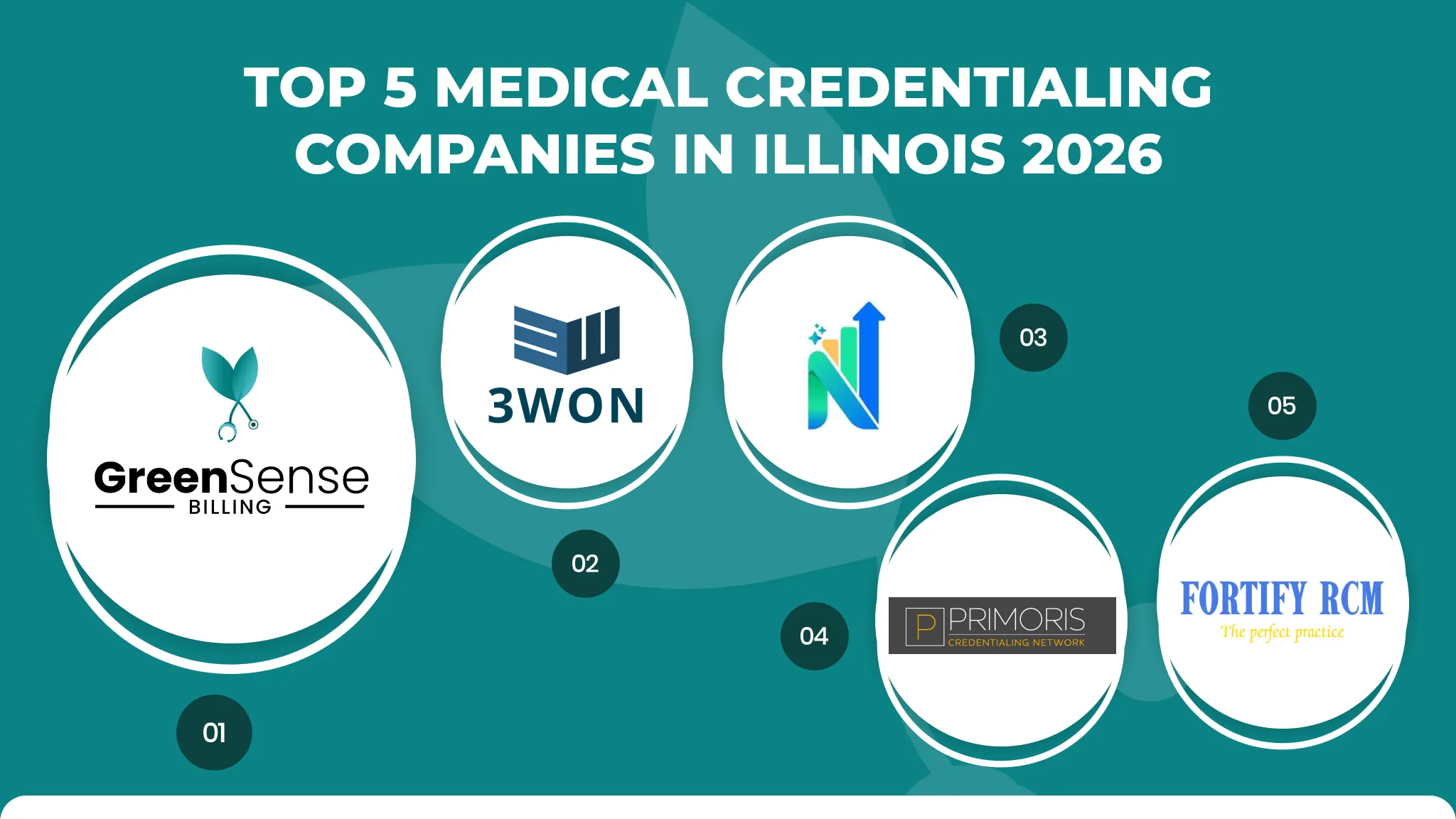
This guide compares five medical credentialing companies in Illinois: GreenSense Billing, 3WON, Neolytix, Fortify RCM, and Primoris Credentialing Network. Every claim below comes from each company's own published pages, checked in October 2026. Where a company does not publish something, we say so rather than guess.
Quick answer: There is no single best credentialing company in Illinois. Pick on three things: whether the vendor handles your actual payers (especially Illinois Medicaid through IMPACT and BCBSIL), whether it publishes a turnaround range it will put in writing, and whether you want credentialing bundled with billing or kept separate. Two of the five here are headquartered in Illinois, 3WON in Naperville and Neolytix in Chicago.
How We Chose These Companies
We looked at companies that publicly document credentialing or payer enrollment work relevant to Illinois providers. For each one we read its own service pages and recorded only what it states there.
The order is not a quality score and it is not a ranking of results, because none of these companies publishes outcome data that can be compared like for like. GreenSense Billing is listed first because we publish this guide, and we say so plainly. After that, companies are ordered by how much documented Illinois relevance they show, starting with the two that are headquartered in the state.
Three things we refused to do: invent pricing where none is published, repeat performance statistics that have no source, and treat a company's marketing claim as a verified fact. Company claims are labelled as company claims throughout.
Quick Comparison
| Company | Best for | Stated turnaround | Pricing |
|---|---|---|---|
| GreenSense Billing |
Practices wanting credentialing and billing from one team | 45 to 90 days, depending on payer response times (company-stated) | Not stated on the credentialing page; a pricing page exists |
| 3WON |
Health systems and large groups wanting CVO plus software | Under 14 days to submit contracted-payer applications; under 28 days to process a full packet (company-stated) | Not publicly stated |
| Neolytix |
Multi-location groups wanting platform-tracked enrollment | Describes turning a 120-day enrollment into roughly 45 days, and cites 60 days as best-in-class time to first bill (company-stated) | Not publicly stated; references fixed-fee and incentive-based options |
| Fortify RCM |
Non-physician and allied provider types, and Illinois Medicaid MCO work | 60 to 90 days per payer (company-stated) | Per provider and per payer; no figure published. States no payment until you are enrolled |
| Primoris Credentialing Network |
Groups that want delegated credentialing through an IPA | Claims roughly 75 days faster than a stated 90 to 120 day industry average (company claim, see note) | Described as a fixed-cost structure; no figure published |
What Credentialing Actually Involves in Illinois
Credentialing verifies your education, licensing, training, and professional history. Payer enrollment is the separate step that approves you to bill a specific insurer. Hospital privileging is a third thing again, deciding which procedures you may perform at a facility. You usually need more than one of these, and each runs on its own clock.
Two Illinois-specific timing facts are worth building your plan around.
State licensing comes first, and it is slow. IDFPR's physician licensing FAQ tells applicants to submit at least 8 to 10 weeks before the date they need the license, and notes that timing varies with the applicant's own ability to produce required documents. The initial application fee is $500 and is non-refundable. Physician licenses expire every third year. If the license is not in hand, payer enrollment has not even started.
Illinois Medicaid enrollment runs through IMPACT, and HFS does not publish a processing time. Before you enroll, HFS requires an NPI, a taxonomy code, a certified W-9 on file, current licensure, a working email address, an IMPACT login, and review of the Medical Provider Handbook. Rendering and servicing-only providers are exempt from the W-9 step. Because HFS publishes no timeframe, any "Illinois Medicaid takes X days" figure you read is a vendor estimate, not a state one. Treat it that way.
A practical sequencing point: start coverage checks before credentialing finishes, not after. Knowing which of your incoming patients are covered by which plan tells you which payer applications to prioritise. GreenSense Billing's eligibility verification service covers this step.
The Five Companies in Detail
1. GreenSense Billing
Publisher of this guideGreenSense Billing is the publisher of this article. It is profiled here using the same fields and the same evidence standard as every other company, and you should weigh it accordingly.
Strengths
- Publishes a specific turnaround range rather than a vague promise
- Credentialing and billing sit with one team, so enrollment and claims stay aligned
- Names the specialties it supports instead of claiming all of them
Not ideal if
- You need a credentialing partner with stated NCQA or URAC accreditation
- You want delegated credentialing through an IPA arrangement
- You want an Illinois-based team on the ground
Best fit: An Illinois practice that wants one vendor handling enrollment and the claims that follow it, and that values a written turnaround range over an accreditation badge.
2. 3WON
Illinois headquarters3WON is a healthcare IT company focused on provider data management, founded in 2010 and based in Naperville. It offers credentialing as software, as a managed CVO service, or as a hybrid of the two.
Strengths
- The fastest stated turnaround figures in this group, and they are specific
- Headquartered in Illinois, so time zone and local payer familiarity are a reasonable expectation
- Offers software-only, fully managed, or hybrid models
- Publishes a SOC 2 Type II security attestation
Not ideal if
- You are a solo provider; the orientation is toward payors, practice groups, and health systems
- You want billing bundled with credentialing
- You need itemized payer coverage before signing
Best fit: An Illinois health system or large group that wants to run credentialing on a platform, with the option of handing specific tasks to a CVO team.
Source: 3WON
3. Neolytix
Illinois headquartersNeolytix is a Chicago-based healthcare operations firm offering CVO services, payer enrollment, licensing, and broader RCM. Its enrollment work is tracked on its own platform, inCredibly.
Strengths
- Chicago headquarters, the most central Illinois location in this group
- Publishes an ISO 27001 certification, which is unusual in this category
- Platform gives visibility into application status and revalidation dates
- Handles medical licensing as well as enrollment, useful for multi-state groups
Not ideal if
- You want conservative, sourced claims; its pages carry several large unsourced figures
- You need turnaround quoted per payer type rather than as an overall average
- You are a single-provider practice
Best fit: A multi-location Illinois group that wants enrollment status and revalidation deadlines visible in a dashboard rather than a spreadsheet.
4. Fortify RCM
Most Illinois payer detailFortify RCM bundles credentialing with billing and focuses heavily on allied and non-physician provider types. Its Illinois page is the only one in this group that names specific Illinois Medicaid managed care organizations.
Strengths
- Names actual Illinois Medicaid MCOs, which no other company here does
- States no payment until you are successfully enrolled, which lowers trial risk
- Covers provider types that physician-focused vendors often decline
- Advertises six months of free billing services alongside credentialing
Not ideal if
- You want a vendor with an Illinois or regional presence; the listed address is in Delaware
- You need stated accreditation
- You are wary of vendors publishing near-identical pages for many states
Best fit: An Illinois behavioral health, therapy, home health, or allied provider that bills Medicaid MCOs and wants credentialing and billing handled together.
5. Primoris Credentialing Network
Delegated credentialingPrimoris is an IPA specialising in delegated credentialing, part of the Fifth Avenue Healthcare Services group. It announced its entry into the Illinois market in November 2022.
On that speed claim: 75 days faster than a 90 to 120 day average would imply completion in roughly 15 to 45 days. Primoris does not publish a resulting turnaround range, and the arithmetic is not explained. Ask for the actual expected range in writing before treating speed as the deciding factor.
Strengths
- States NCQA Credentialing Accreditation
- Names two specific third-party audits with dates, which is rare in this category
- Delegated contracts can shorten enrollment where the payer participates
- One application covering multiple plans reduces administrative duplication
Not ideal if
- Your main payers are not among its delegated Illinois contracts
- You want a longer Illinois track record; it entered the state in late 2022
- You need billing services as well as credentialing
Best fit: An Illinois group whose priority payers already sit inside Primoris's delegated contracts, and that wants accreditation and audit evidence on file.
Which Should You Shortlist?
How to Choose a Credentialing Company in Illinois
Ask every vendor the same questions in the same order, and write the answers down. Vague answers are information too.
- What turnaround range will you put in writing, and what falls outside your control?
- Do you handle Illinois Medicaid enrollment through IMPACT directly?
- Which Medicaid MCOs have you enrolled providers with in the last year?
- Are you contracted or delegated with BCBSIL?
- Who tracks my re-credentialing and revalidation dates after approval?
- How often do you re-attest my CAQH profile?
- What exactly does your fee include, and what is billed separately?
- Is there a minimum contract term?
- Can I see application status without emailing you?
- What happens, at your cost, if an application is denied?
Common mistakes that cost Illinois practices money
Starting credentialing before the license is secured. IDFPR asks for 8 to 10 weeks' lead time. Payer applications that reference a pending license tend to stall.
Treating vendor Medicaid estimates as state timelines. HFS publishes no IMPACT processing time. If a vendor quotes one confidently, ask where the number comes from.
Letting CAQH attestation lapse mid-application. An expired attestation can quietly stop an application that otherwise looks fine.
Forgetting revalidation. Most payers re-credential on a two to three year cycle, and Illinois physician licenses expire every third year. A missed date can mean removal from a network.
Choosing on headline speed. Payer response time is largely outside any vendor's control. A firm that explains which parts it controls is more trustworthy than one quoting the shortest number.
If your providers already practise across state lines, or you are weighing Illinois against other markets, our Illinois medical billing overview covers the payer landscape in more detail, and the guide to CAQH credentialing explains the profile step that trips up most applications.
What Happens After Approval
Approval is the start of the billing relationship, not the end of the admin. Three things need an owner from day one.
Effective dates. Confirm the exact date you may begin billing each payer. Claims submitted before it will be denied, and retroactive billing rules vary by payer.
Clean claim setup. EDI, ERA, and EFT enrolment should be completed alongside credentialing so payments actually arrive electronically. Where denials start appearing anyway, denial management is the function that catches the pattern before it becomes an AR problem.
The expiry calendar. Licences, DEA registrations, malpractice coverage, board certifications, and CAQH attestations all expire on different cycles. Someone needs to own that calendar.
Get your payer approvals on a timeline you can plan around
GreenSense Billing handles provider credentialing and the billing that follows it, so enrollment and claims stay connected instead of sitting with two vendors who do not talk to each other. Tell us your payers and specialty and we will tell you what is realistic.
Talk to our credentialing teamFinal Thoughts
The honest summary is that none of these five publishes enough comparable data to crown a winner, and any article that claims otherwise is guessing. What you can compare is specificity: who names your payers, who commits to a range in writing, who tells you what their fee covers.
Shortlist two, ask them the same ten questions, and choose the one whose answers are the most concrete. If you want enrollment and revenue cycle management under one roof, that is the conversation we are set up to have.
Sources
Frequently Asked Questions (FAQs)
What is the difference between medical credentialing and provider enrollment in Illinois?
Credentialing verifies your qualifications: education, licensing, training and professional history. Provider enrollment is the separate step that approves you to bill a specific payer, such as Illinois Medicaid through the IMPACT system. You normally need both, and each has its own timeline. Hospital privileging, which decides what procedures you may perform at a facility, is a third and separate process.
Q2. How long does credentialing take in Illinois?
It depends on the payer, and no vendor fully controls it. Published company figures in this comparison range from under 28 days to process a packet up to 90 to 120 days for commercial payers. Illinois HFS publishes no processing time for Medicaid enrollment through IMPACT, so any Medicaid-specific figure you read is a vendor estimate rather than a state one.
Q3. How far ahead should I apply for an Illinois physician license?
IDFPR strongly encourages applicants to submit at least 8 to 10 weeks before the date they need the license. The agency notes that timing varies with each applicant's ability to produce supporting documents, and recommends submitting the application and all documentation together. The initial application fee is $500 and is non-refundable.
What do I need before enrolling with Illinois Medicaid through IMPACT?
Illinois HFS lists seven prerequisites: a National Provider Identifier, a taxonomy code, a certified W-9 on file, current professional certification or licensure, a working email address and compatible browser, an IMPACT login, and review of the Medical Provider Handbook. Rendering and servicing-only providers are exempt from the W-9 requirement.
How much does medical credentialing cost per provider in Illinois?
None of the five companies compared here publishes a dollar figure, so we will not invent one. Primoris describes a fixed-cost structure with no hidden fees. Fortify RCM prices per provider and per payer, and states there is no payment until you are successfully enrolled. Expect to request a written quote that itemises what is included.
Do credentialing companies handle re-credentialing and revalidation?
Many do, but confirm who owns the calendar. GreenSense Billing lists re-credentialing and ongoing maintenance, 3WON offers ongoing credential monitoring, and Neolytix tracks revalidation dates on its platform. Most payers re-credential on a two to three year cycle, and Illinois physician licenses expire every third year, so a missed date can mean removal from a network.
Should I pick a dedicated credentialing company or one bundled with billing?
A dedicated credentialing firm may offer deeper focus on enrollment alone. A bundled provider keeps enrollment and claims aligned, which matters because effective dates, EDI setup and early denials all sit on the boundary between the two. Credentialing and billing are genuinely different businesses, though several companies do both.
Does an NCQA-accredited vendor matter for a small Illinois practice?
It matters most if you need delegated credentialing or formal primary source verification, which are usually health system and large group requirements. Primoris states NCQA Credentialing Accreditation. 3WON describes NCQA-compliant software and displays an NCQA CVO badge, so confirm the exact scope directly. For a small practice, payer coverage and written turnaround usually matter more.


More Related Posts

-
October 2, 2026
Billing GuidesTop 5 Medical Credentialing Companies in Florida (2026)
Compare the top medical credentialing companies in Florida for 2026: services, turnaround times, pricing, and the AHCA deadlines that shape...
-

October 1, 2026
Billing GuidesTop 5 Medical Credentialing Companies in Texas for 2026
Compare five medical credentialing companies in Texas on services, turnaround, payers, and accreditation, plus the Texas rules (TSCA, PEMS,...
-

September 25, 2026
Billing GuidesBest Medical Credentialing Companies in the USA (2026)
Compare the top medical credentialing companies in the USA for 2026: turnaround times, payer networks, and pricing, so you can pick the righ...
-
September 24, 2026
Billing GuidesCost of Medical Credentialing in California in 2026
Learn the 2026 cost of medical credentialing in California, including payer enrollment, CAQH, Medicare, Medi-Cal, licensing, and ongoing fee...
-
September 23, 2026
Billing GuidesTop 7 Medical Credentialing Services for California (2026)
Navigate California's Medi-Cal, HMO, and commercial credentialing. Compare the top 7 medical credentialing services for California practices...
-

September 22, 2026
Billing GuidesTop 5 Medical Credentialing Companies in California (2026)
Compare the top 5 medical credentialing companies in California for 2026 — ranked by Medi-Cal MCO experience, turnaround time, specialty cov...
-
September 18, 2026
Billing GuidesTop 10 Medical Credentialing Companies in the USA (2026)
Compare the top 10 medical credentialing companies in the USA for 2026 by turnaround time, payer coverage, specialties, pricing, and verifie...
-

September 14, 2026
Billing GuidesTop 10 Medical Billing Companies in New York (2026)
Compare the top Medical Billing Companies in New York on NY Medicaid, Empire BCBS, and behavioral health experience to find the right partne...
-
September 11, 2026
Billing GuidesTop 10 Medical Billing Companies in California (2026)
Compare the top Medical Billing Companies in California on Medi-Cal, HMO, and AB 72 experience to find the right billing partner for your pr...
-
September 10, 2026
Billing GuidesTop 10 Medical Billing Companies in Texas to Outsource (2026)
Compare the top Medical Billing Companies in Texas to Outsource on Texas MCO experience, pricing, and outsourcing model to find the right pa...
-

September 9, 2026
Billing GuidesTop 10 Medical Billing Companies in Texas (2026)
Compare the top Medical Billing Companies in Texas on Texas Medicaid, BCBSTX, and payer expertise to find the right RCM partner for your pra...